
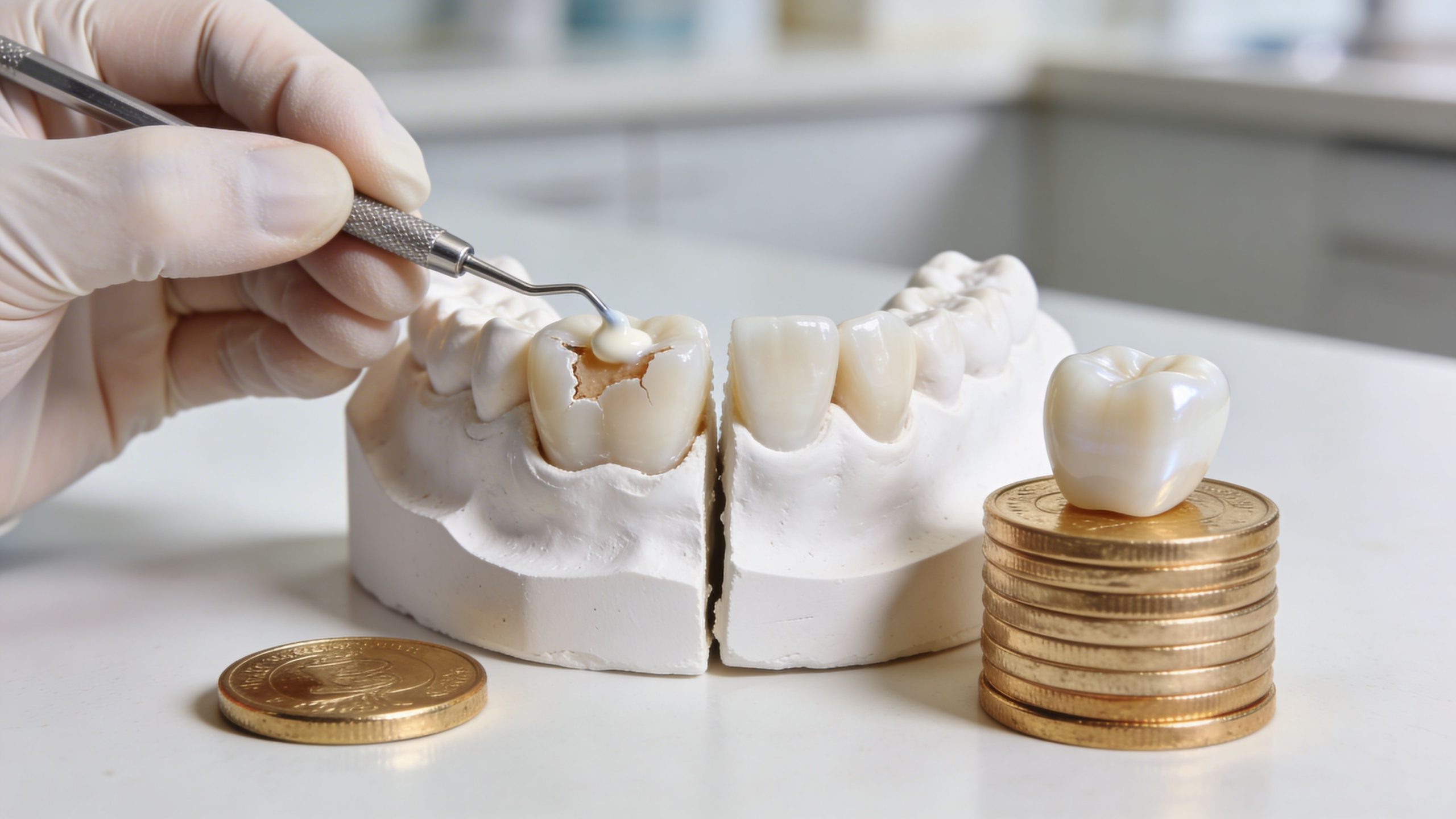
If you’re searching for a cosmetic dentist near me in Rancho Bernardo, you’re probably asking a very practical question. You want your smile to look better, but you also want to know what the true cost will be, not just at the first visit, but over time.
That’s where the dental bonding vs veneers cost conversation gets more useful. A small chip, uneven edge, gap, or stubborn discoloration can make you hesitate in photos, at work, or even when meeting people around San Diego. Most patients don’t just want a prettier smile. They want a choice that fits their goals, schedule, and budget without regret later.
Your Confident Smile Starts in Rancho Bernardo
A lot of people in Rancho Bernardo, Poway, and Rancho Peñasquitos live active, social lives. They’re at dinners with friends, school events, work meetings, weekend outings, and family photos. When someone feels self-conscious about a chipped front tooth or uneven smile, it tends to show up in all of those moments.
Some patients come in saying they’ve hidden the same flaw for years. Others have one tooth that catches the light differently, or a gap that has always bothered them but never felt urgent enough to fix. Then an engagement photo, job change, reunion, or simple desire to feel more polished finally pushes the question forward.

Why this choice feels bigger than cosmetics
Bonding and veneers can both improve a smile, but they serve different kinds of patients well. One is often ideal for a focused, conservative repair. The other makes more sense when someone wants a broader, longer-lasting transformation.
A cosmetic treatment should match the way you live, not just the way your teeth look on day one.
That matters if you’re comparing providers while looking for a dentist in San Diego, CA or a best dentist in Rancho Bernardo, CA option that can handle both cosmetic and restorative planning. Many smiles need more than a quick visual fix. Some patients also need cleaning and exams, dental x-rays, whitening, replacement of older fillings, or coordination with Invisalign before cosmetic work.
A local, patient-first approach
At our Rancho Bernardo office, the conversation starts with what bothers you, what you want changed, and how long you want the result to last. Some people want the most conservative option possible. Others would rather invest once and avoid repeated upkeep.
That kind of planning matters because cosmetic dentistry isn’t one-size-fits-all. A treatment that’s perfect for one tooth may not be the right choice for six. A fast fix isn’t always the cheapest choice long term. And the right answer depends on your enamel, bite, habits, budget, and expectations.
Understanding Your Smile Makeover Options
Before looking at prices, it helps to understand what each treatment does.
What dental bonding is
Dental bonding uses tooth-colored composite resin that’s placed directly on the tooth, shaped by the dentist, and polished to blend in. It’s commonly used for minor chips, small gaps, uneven edges, and limited discoloration.
Bonding has a lower upfront cost and is usually faster. Dental bonding typically ranges from $100 to $600 per tooth, takes about 30 to 60 minutes per tooth in a single visit, and lasts about 3 to 10 years.
For patients exploring conservative cosmetic treatment, our page on cosmetic bonding gives a useful overview of how this option works in everyday practice.
What porcelain veneers are
Porcelain veneers are thin custom-made shells that cover the front surface of the tooth. They’re designed for larger cosmetic changes in color, shape, symmetry, and overall smile design.
They take more planning because the result is more extensive. The veneer process usually involves tooth preparation, records or impressions, lab fabrication, and a later placement visit.
The main difference patients feel
Bonding is usually best for a smaller correction. Veneers are usually better when a patient wants multiple teeth to look more uniform and stay that way longer.
Here is a simple comparison:
| Treatment | Best for | Visit style | Material | Typical role |
|---|---|---|---|---|
| Dental bonding | Small chips, narrow gaps, minor shape changes | Usually single visit | Composite resin | Conservative cosmetic repair |
| Porcelain veneers | Broader smile changes across visible teeth | Multi-visit process | Lab-made porcelain | Full smile refinement |
Practical rule: If the goal is to fix one thing on one tooth, bonding is often the first option worth discussing. If the goal is to redesign the smile across several front teeth, veneers usually deserve a serious look.
What works well and what doesn’t
Bonding works well when the underlying tooth is healthy and the cosmetic issue is limited. It doesn’t work as well when someone wants major color changes across several front teeth or expects a highly polished look to stay unchanged for many years.
Veneers work well when the patient wants consistency, stain resistance, and durability. They’re less ideal for someone who wants the most reversible option or only needs a tiny touch-up.
Dental Bonding vs Veneers Cost A Detailed Breakdown
Patients usually start with the per-tooth price. That’s understandable, but it doesn’t tell the whole story.
What you’re paying for with each option
With bonding, the lower fee reflects a chairside procedure. The resin is applied directly, shaped in real time, and finished in the office. There’s no lab-made porcelain shell and usually no multi-appointment sequence.
With veneers, the fee is higher because the process includes custom porcelain fabrication, added planning, and a more detailed fit and finish. Veneers also tend to involve more preparation and a longer treatment pathway.
Here’s the side-by-side view most patients want early:
| Cost factor | Dental bonding | Porcelain veneers |
|---|---|---|
| Typical per-tooth range | $100 to $600 | $900 to $2,500 |
| National average often cited | $431 | $1,817 |
| Insurance | Often limited for cosmetic cases | Rarely covered for cosmetic cases |
| Financing | Often available | Often available |
What San Diego patients should expect
Costs in this area can run above national averages. In major U.S. markets like San Diego, dental costs can be 25 to 50 percent higher than national averages, and financing options such as CareCredit can break treatment into monthly payments often between $50 and $200 per tooth, according to this CareCredit overview of teeth bonding costs.
That local reality matters when someone searches for a dentist near me and compares prices online. A national price range may be technically accurate, but it may still feel disconnected from what a patient in Rancho Bernardo sees during a consultation.
For a closer look at veneer planning and cost considerations, our page on the cost of dental veneers can help frame the questions worth asking before treatment.
Why one quote can differ from another
A fee can change based on several practical issues:
- How many teeth are involved. One repaired corner is very different from redesigning six or eight visible teeth.
- How difficult the color match is. Front teeth demand more precision.
- How much shaping is needed. A simple fill-in costs less than a detailed aesthetic redesign.
- Whether other care comes first. Some patients need cleaning, gum treatment, replacement fillings, or bite adjustments before cosmetic work.
The right cosmetic plan should make financial sense both today and two maintenance visits from now.
What doesn’t help patients
A low quote without a discussion of longevity isn’t very helpful. Neither is a high quote without explaining what the patient gets in durability, polish, stain resistance, and fewer future touch-ups.
That’s why dental bonding vs veneers cost should always be discussed as both upfront investment and total ownership over time.
Comparing Procedure Longevity and Maintenance
The biggest mistake patients make is assuming the cheapest first visit is automatically the least expensive choice. Sometimes it is. Sometimes it isn’t.
How the treatment experience differs
Bonding is usually straightforward. The tooth is prepared lightly, resin is added, the shape is refined, and the surface is polished. For many patients, that’s the appeal. It’s direct and efficient.
Veneers are more involved. The teeth are evaluated carefully, a small amount of enamel is typically adjusted, records are taken, and the porcelain is fabricated before final placement. That extra time is part of why veneers feel more like a long-term cosmetic restoration than a quick repair.
Where longevity changes the math
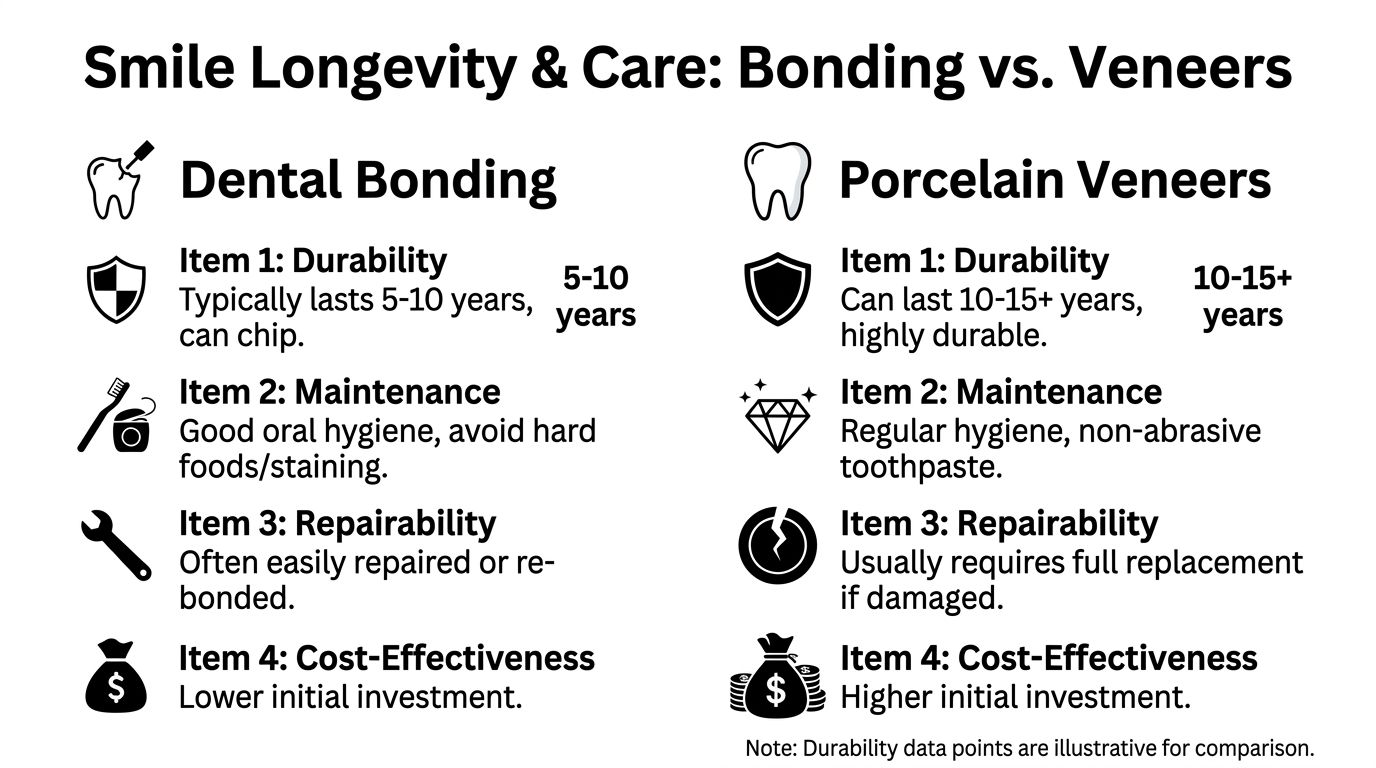
The durability gap is real. Porcelain veneers have a 10 to 15+ year lifespan, high stain resistance, and flexural strength of 100 to 150 MPa. Bonding typically lasts 5 to 7 years, has moderate strength of 50 to 100 MPa, and is more prone to staining.
That same source notes veneers require 0.3 to 0.5 mm of enamel preparation, while bonding usually requires minimal to no enamel removal. It also reports a less than 5 percent fracture rate for veneers over 10 years, compared with a 10 to 20 percent chip risk for bonding.
What daily maintenance feels like
Patients don’t experience longevity as a number. They experience it as inconvenience or peace of mind.
Bonding may need:
- More caution with staining foods and drinks because composite can discolor over time
- More awareness of hard biting habits such as ice, pens, or nail biting
- Periodic touch-ups or repairs if an edge chips or dulls
Veneers usually mean:
- A more stable color over time
- Less worry about surface staining
- Fewer cosmetic maintenance visits for the treated teeth, assuming normal wear and good habits
If you want a smile upgrade and don’t want to think about it often afterward, veneers usually fit that goal better.
What works for different kinds of wear
Bonding performs best in lower-stress cosmetic situations. A tiny chip on a front tooth is a classic example. It’s conservative, efficient, and often looks very natural when done well.
Veneers tend to perform better when several front teeth need coordinated changes or when a patient wants more resistance to wear and staining over the years.
That doesn’t mean veneers are automatically better. It means they’re often better for the patient who is tired of patchwork cosmetic repairs and wants a more durable finish.
Which Cosmetic Treatment is Right for Your Smile
The best choice depends less on what sounds nicer online and more on what problem you are trying to solve.

Bonding makes sense when
Bonding is usually the smarter option when the issue is small, local, and you want a conservative fix.
That includes situations like:
- One chipped edge that needs reshaping
- A small gap between front teeth
- A minor contour problem that distracts from an otherwise healthy smile
- A short timeline when you want improvement quickly
If you’re mainly looking for a practical cosmetic update without committing to a larger treatment plan, bonding often does the job well.
Veneers make sense when
Veneers become more compelling when the goal is bigger than one repair. They’re often the right fit for patients who want multiple front teeth to look more even, brighter, and more symmetrical for the long haul.
For 6 teeth over 15 years, bonding could cost $2,400 to $10,800 in total, while veneers at $900 to $2,500 per tooth would be a one-time cost of $5,400 to $15,000, which often makes veneers the stronger long-term investment in higher-cost areas like San Diego.
That’s the total cost of ownership issue many patients miss. Bonding can absolutely be the right call. It just isn’t always the lower-cost choice over the full life of the smile.
A few real-world decision cues
| If this sounds like you | Usually worth discussing first |
|---|---|
| “I have one tooth that chips or looks uneven.” | Bonding |
| “I want a quick cosmetic improvement.” | Bonding |
| “I want several front teeth to match each other better.” | Veneers |
| “I want a smile that stays polished with less upkeep.” | Veneers |
Some smiles also need combination planning. A patient may benefit from whitening first, then bonding, or Invisalign first, then veneers. Others may have gum display concerns that affect the final result. In those cases, it can be helpful to review related solutions for a gummy smile so the full smile picture is considered, not just the teeth alone.
The right cosmetic choice should fit your smile, your habits, and your tolerance for maintenance.
One practical note on candidacy
If a patient clenches, grinds, has untreated gum disease, or has bite issues, the cosmetic discussion has to include those problems too. Sometimes the smartest move is to stabilize the mouth first, then choose bonding or veneers. That’s also why a practice that handles cosmetic dentistry, restorative dentistry, routine dental care, and nightguard planning can give more useful guidance than a price quote alone.
Your Smile Consultation at Our Rancho Bernardo Office
Most patients feel better about this decision once they see their teeth up close, talk through their priorities, and get a clear recommendation without pressure.
What the first visit is like
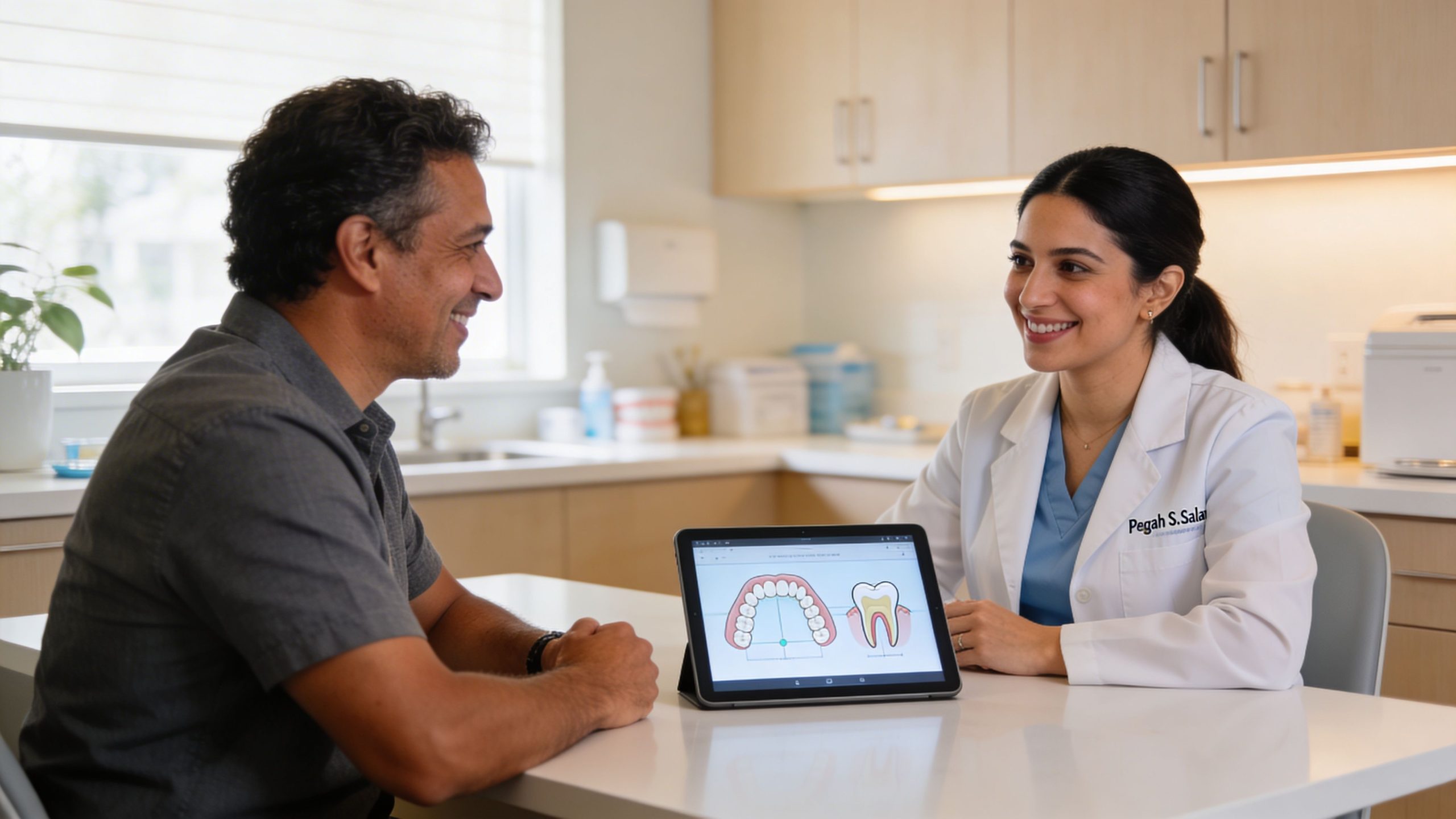
A cosmetic consultation at our Rancho Bernardo office starts with listening. Some patients arrive focused on veneers. Others assume they need bonding because it sounds simpler. Once the teeth, bite, enamel, and gumline are evaluated, the answer sometimes changes.
The visit may include:
- A discussion of your goals so the plan reflects what you want to improve
- A thorough exam and dental x-rays if needed to check the health behind the cosmetic concern
- Photos or visual planning to compare shape, symmetry, and shade
- A treatment sequence if whitening, fillings, aligners, or restorative care should come first
How budget conversations are handled
A useful cosmetic consultation shouldn’t leave you guessing. You should know whether the issue can be solved conservatively, whether a larger treatment plan would produce a better result, and what the trade-offs are.
Some patients want the most affordable path today. Others want the option that minimizes repeat work later. Both are reasonable goals.
At Pegah S. Salami, DMD, FAGD, cosmetic planning is one part of a full-service dental visit, which can be helpful when a smile plan overlaps with whitening, restorative needs, or ongoing family dental care.
Who we serve locally
Patients often visit from Rancho Bernardo, Poway, Escondido, and Rancho Peñasquitos because they want a practice that can handle more than one issue at a time. That matters if you’re also looking for cleaning and exams, new patient exams, teeth whitening, restorative dentistry, or even help from an emergency dentist if a tooth chips unexpectedly.
Good cosmetic care starts with clarity. You should leave the consultation knowing what will work, what won’t, and why.
The first appointment should make the decision easier, not more confusing. That’s the standard patients deserve.
Frequently Asked Questions About Bonding and Veneers
Can you whiten dental bonding or veneers
Whitening treatments don’t lighten bonding material or porcelain the way they lighten natural enamel. If shade is part of your goal, it’s usually better to discuss whitening before final cosmetic work so the new restoration can match your preferred color.
Is the veneer procedure painful
Most patients tolerate veneer treatment well. The teeth are evaluated carefully, and the process is planned to keep you comfortable. If you’re anxious, say so early. Comfort options and pacing can make a major difference.
Is getting veneers reversible
Veneers are generally considered a long-term treatment because they usually involve some enamel preparation. Bonding is more conservative and often preserves more natural tooth structure.
Can I get bonding or a veneer on just one tooth
Yes, in many cases you can. Single-tooth treatment is common when the issue is isolated, such as one chipped tooth or one tooth with unusual shape or color. The main concern is matching the surrounding teeth naturally.
How do I care for bonded teeth or veneers
Daily care matters for both:
- Brush and floss consistently to protect the tooth and gumline around the restoration
- Avoid using teeth as tools for packages, nails, or hard objects
- Keep regular dental visits so small wear issues can be caught early
- Mention grinding or clenching if you wake up sore or wear through restorations
Which one looks more natural
Both can look natural when chosen well and done carefully. Veneers usually allow more control over color, symmetry, and overall smile design. Bonding can look excellent for smaller corrections.
If you’re weighing dental bonding vs veneers cost and want a clear recommendation based on your smile, your budget, and your timeline, schedule a consultation with Pegah S. Salami, DMD, FAGD. Patients from Rancho Bernardo, Poway, Rancho Peñasquitos, Escondido, and nearby San Diego communities can get practical guidance, a thorough exam, and a treatment plan that makes sense for both appearance and long-term value.





