

Deciding to restore your smile with dental implants is a major step toward reclaiming your confidence and quality of life. As a trusted local dentist in San Diego, we understand that it's a significant investment in your health. That's why we believe it's so important for our patients to understand every part of the process—including the rare possibility that an implant could fail.
The great news is that dental implants have an incredible success rate, with over 95% of procedures resulting in a stable, long-lasting tooth. But when problems do occur, they usually fall into two categories: early failures, which happen shortly after surgery, and late failures, which can appear years later. If you're experiencing pain or are worried about your implant, you've come to the right place for answers. Our goal is to be the best dentist in Rancho Bernardo for patients seeking clear, compassionate care.
Understanding Why Dental Implants Fail
At the office of Dr. Pegah S. Salami, we believe an informed patient is an empowered one. Knowing why an implant might fail is the first, and most important, step toward preventing it. We're committed to helping you protect your investment so your new tooth lasts a lifetime. Whether you're searching for "dental implants near me" or need an "emergency dentist" to look at a current implant, our San Diego team is here for you.
This chart gives you a quick visual breakdown of the two main types of implant failure—early and late—and what causes them.

As you can see, the timing of a problem often tells us a lot about its source. It helps us separate immediate healing issues from challenges that develop over the long term.
Early vs. Late Implant Complications
Implant failure isn't a single event. It’s a process that can unfold at two very different times. Knowing the difference helps our patients in Rancho Bernardo, CA, recognize potential issues before they become serious.
Early Failure: This type of failure happens within the first few months after surgery. It usually means the implant didn't fuse properly with the jawbone—a critical process called osseointegration.
Late Failure: This occurs months or even years after the implant has fully healed and been restored. These problems tend to develop slowly and are often related to long-term dental care and hygiene.
It’s helpful to see the causes side-by-side to understand what we’re looking out for at different stages of your implant journey.
Early vs. Late Dental Implant Failure Causes
| Failure Type | Primary Causes | When It Occurs |
|---|---|---|
| Early Failure | – Post-operative infection – Poor healing response – Insufficient bone volume or density – Smoking or underlying health conditions – Surgical error or implant placement issues |
Within the first 3-4 months after surgery |
| Late Failure | – Peri-implantitis (gum disease around the implant) – Poor long-term oral hygiene – Excessive biting force (teeth grinding, clenching) – Mechanical failure of implant components – Misaligned bite putting stress on the implant |
Months or years after the implant has fully integrated |
Both types of failure are largely preventable with expert placement, thorough follow-up care, and your commitment to maintaining your oral health.
The success of a dental implant all comes down to one thing: creating and keeping a strong, stable bond between the implant and your jawbone. Anything that gets in the way of that bond, whether it’s an infection right after surgery or gum disease a decade later, is something we need to address.
The reasons behind early and late failures are quite distinct. Early issues are often tied to the surgery itself or your body's initial healing response. This could be an infection, not having enough bone to securely hold the implant, or habits like smoking that dramatically slow down the healing process.
Late failures, on the other hand, are almost always caused by things that happen long after your smile is complete. The most common culprit is peri-implantitis, a type of gum disease that attacks the bone supporting the implant. Other factors include chronic teeth grinding, which puts too much stress on the implant, or simply neglecting to brush and floss around your new tooth.
Here in our San Diego practice, serving patients from Rancho Bernardo to Poway, we focus on minimizing these risks from day one. By choosing an experienced team and committing to your own dental care, you can protect your investment and enjoy a healthy, beautiful smile for years to come.
Early Implant Failure During Healing
Those first few months after your dental implant is placed are incredibly important. This is the healing window where a process called osseointegration takes place—it’s where the implant post literally fuses with your jawbone, creating that rock-solid foundation for your new tooth. If something gets in the way of this crucial connection, it can lead to what we call early implant failure.
Think of it like planting a tree. For it to grow strong, it needs healthy soil and to be left alone so its roots can take hold. Your dental implant is no different. It needs the right conditions in your jaw to heal and integrate perfectly, and at our Rancho Bernardo dental office, we guide you every step of the way.

Key Factors in Early Healing
So, what can get in the way of osseointegration? Understanding these factors helps explain why an implant might fail early on and highlights why following your post-op instructions is so critical.
- Post-Surgical Infection: An infection at the implant site is a major threat. It can attack the healing tissues and stop the bone from growing onto the implant surface.
- Poor Blood Flow: Healing completely depends on a rich supply of blood to deliver oxygen and nutrients. Any habit or health condition that restricts blood flow can essentially starve the area, slowing or stopping recovery.
- Too Much Pressure Too Soon: Putting pressure on a new implant before it’s fully integrated is a big no-no. Even tiny micro-movements can disrupt the delicate bond that’s trying to form with the bone.
This is exactly why the initial evaluation at our San Diego practice is so comprehensive. Dr. Salami assesses every patient’s unique health profile to create a personalized plan that minimizes these risks right from the start.
The Role of Bone Health
A strong, healthy jawbone is non-negotiable for implant success. If the bone is too soft or doesn't have enough volume, it simply can’t provide the stable base the implant needs to fuse. It’s like trying to drive a screw into crumbling drywall—it’s just not going to hold.
When there isn’t enough bone, osseointegration can fail. Thankfully, this is a problem our dental practice can solve. If you've experienced bone loss, a tooth extraction, or have gone a long time with a missing tooth, we may recommend a bone graft. This restorative dentistry procedure rebuilds a solid foundation, making a successful implant possible.
The success of osseointegration is a partnership. While your dentist ensures perfect placement, your body's ability to heal and your commitment to post-operative care are just as important for creating a lasting bond.
The Impact of Smoking on Healing
Your lifestyle choices play a huge part in healing, and smoking is, without a doubt, the single greatest risk factor for early implant failure. Nicotine is a vasoconstrictor, which is a technical way of saying it tightens blood vessels and chokes off the blood supply that’s essential for healing. This lack of oxygen and nutrients can bring osseointegration to a grinding halt.
The numbers don't lie. One major study found that smoking was a factor in a staggering 37% of all implant failures. To put that in perspective, healthy non-smokers had a failure rate of just 4.37%. The data makes it clear just how dramatically smoking impacts long-term implant health.
For our patients in Poway and Rancho Peñasquitos, we can’t stress this enough: quitting tobacco is one of the most powerful things you can do to protect your new implant. Dr. Salami and our team are here to provide the guidance and support you need to achieve the healthy, beautiful smile you deserve.
Late Implant Failure and Long-Term Health
It’s a scenario we help patients avoid: a dental implant that feels perfect for years suddenly starts to cause trouble. This is what we call late implant failure, and it almost always comes down to long-term health and maintenance, not the initial healing. The implant integrated beautifully, but something has changed down the road.
For our patients from Rancho Peñasquitos to Escondido, we want to do more than just place a beautiful implant. We want to give you the tools and knowledge to keep it healthy for life. Protecting your smile is a team effort, and we’re your partners in it.

The Primary Cause of Late Failure: Peri-Implantitis
By far, the biggest threat to a mature dental implant is a condition called peri-implantitis. The simplest way to think about it is as gum disease, but for an implant. It’s an infection driven by plaque and bacteria that attacks the gums and, critically, the bone holding your implant firmly in place.
Think of a strong fence post anchored in concrete. If the ground around it erodes and the concrete foundation starts to crumble away, that post will get wobbly and eventually fail. That's exactly what happens to a dental implant when peri-implantitis destroys the supporting bone.
Since peri-implantitis is so closely tied to gum health, learning how to prevent gum disease naturally is a huge part of safeguarding your implant. This is why we say that regular dental care is simply non-negotiable for implant patients.
Other Long-Term Risk Factors
While peri-implantitis is the main offender, a few other issues can create problems years after your implant has been placed. Often, these factors work together, creating a perfect storm for failure.
- Excessive Mechanical Stress: Implants are incredibly strong, but they aren't indestructible. Chronic teeth grinding or clenching (a condition called bruxism) puts immense, repetitive force on the implant and its crown. Over time, this can lead to the hardware breaking or bone loss around the titanium post.
- Poor Oral Hygiene: This is the most direct path to peri-implantitis. If you aren't brushing and flossing diligently around the implant, you're rolling out the red carpet for the very bacteria that cause destructive inflammation.
- Changes in Your Overall Health: Your body is a connected system. Developing a condition like uncontrolled diabetes or osteoporosis years after getting your implant can compromise your body’s ability to fight infection and maintain healthy bone, making your implant more vulnerable.
The long-term success of a dental implant is not just about how it was placed; it's about how it's maintained. Your daily habits and regular professional check-ups are your best defense against late failure.
Protecting Your Smile for the Future
Here’s the good news: late implant failure is almost always preventable. It all comes back to that partnership between you and your dental team. At our Rancho Bernardo practice, we see our patients as part of our community, and we are dedicated to helping you protect your smile for decades to come.
Regular dental cleanings and exams are your first line of defense. During these visits, we’re doing much more than just cleaning your teeth. We’re carefully measuring the gums around your implant and taking targeted x-rays to monitor your bone levels. Catching the earliest whispers of trouble allows us to step in before it becomes a real problem.
If you grind your teeth, a custom-fitted nightguard is an easy way to protect your implant from extreme forces while you sleep. But nothing beats a consistent, daily at-home hygiene routine. Think of it as essential maintenance for a high-performance machine. By working together, we can address why dental implants fail and ensure yours stands the test of time.
How We Ensure Implant Success In San Diego, CA
While it’s good to understand why dental implants can fail, it’s far more reassuring to know how we work to prevent it. Here at our San Diego practice, our entire approach is built around giving you a stable, confident smile that lasts for the long haul.
Success isn't an accident; it's the direct result of meticulous planning, precision, and a genuine partnership with you. Our commitment to your success starts long before you ever sit in the dental chair. For every patient in San Diego considering this life-changing treatment, we begin with a comprehensive evaluation to get a complete picture of your oral and overall health.
Meticulous Planning And Advanced Diagnostics
The most critical part of implant dentistry happens before we even pick up an instrument. We use advanced 3D imaging—a Cone Beam Computed Tomography or CBCT scan—to create a detailed digital map of your mouth. This isn't your average flat dental x-ray; it gives us an incredible three-dimensional view of your jawbone, nerves, and sinuses.
This amazing technology allows us to:
- Assess Bone Quality and Quantity: We can measure the exact density and volume of your jawbone to make sure it can provide a rock-solid foundation for the implant. If your bone needs a little help, we can plan a bone graft to build it up first.
- Create a Surgical Guide: Using the 3D scan, we digitally plan the perfect position, angle, and depth for your implant. This virtual plan is then used to create a custom surgical guide, which acts as a precise blueprint during your procedure.
- Avoid Vital Structures: That 3D view lets us map out the exact location of sensitive nerves and sinuses, so we can perform the surgery with an incredible level of precision and safety.
This level of detail completely eliminates guesswork. It transforms the procedure from a freehand operation into a guided, predictable process, dramatically lowering the risk of surgical issues that can cause early failure. For our patients in Rancho Bernardo and the surrounding communities, it simply means peace of mind.
State-Of-The-Art Surgical Techniques
Dr. Salami combines years of hands-on experience with the latest surgical techniques to make your procedure as smooth and effective as possible. We focus on minimally invasive placement, which means smaller incisions and less disruption to your gum tissue. This approach not only makes the experience more comfortable but also promotes faster healing and reduces swelling.
By using the custom surgical guides we create during planning, Dr. Salami ensures the implant is placed exactly where it was intended to go. This perfect placement is the key to achieving osseointegration—that all-important fusion between the implant and your bone.
The ultimate goal of implant surgery isn't just to place an implant; it's to place it in the ideal position to support a beautiful, functional crown that will withstand the forces of chewing for years to come. Our technology and technique make that precision possible.
Your Partners In Long-Term Success
Our care doesn’t stop once your surgery is finished. We truly believe that one of the most important things we can do is empower you with the right knowledge. We’ll provide you with clear, detailed instructions on how to care for your implant, both during the delicate healing phase and for the rest of your life.
From showing you the proper cleaning techniques to scheduling your follow-up visits, we’re your partners every step of the way. We want to ensure that the beautiful work we provide lasts a lifetime. For more great advice, you can check out our detailed guide on how to care for your dental implants to keep your new smile healthy.
By working together, we can turn the possibility of failure into a story of lasting success.
Warning Signs Of A Failing Dental Implant
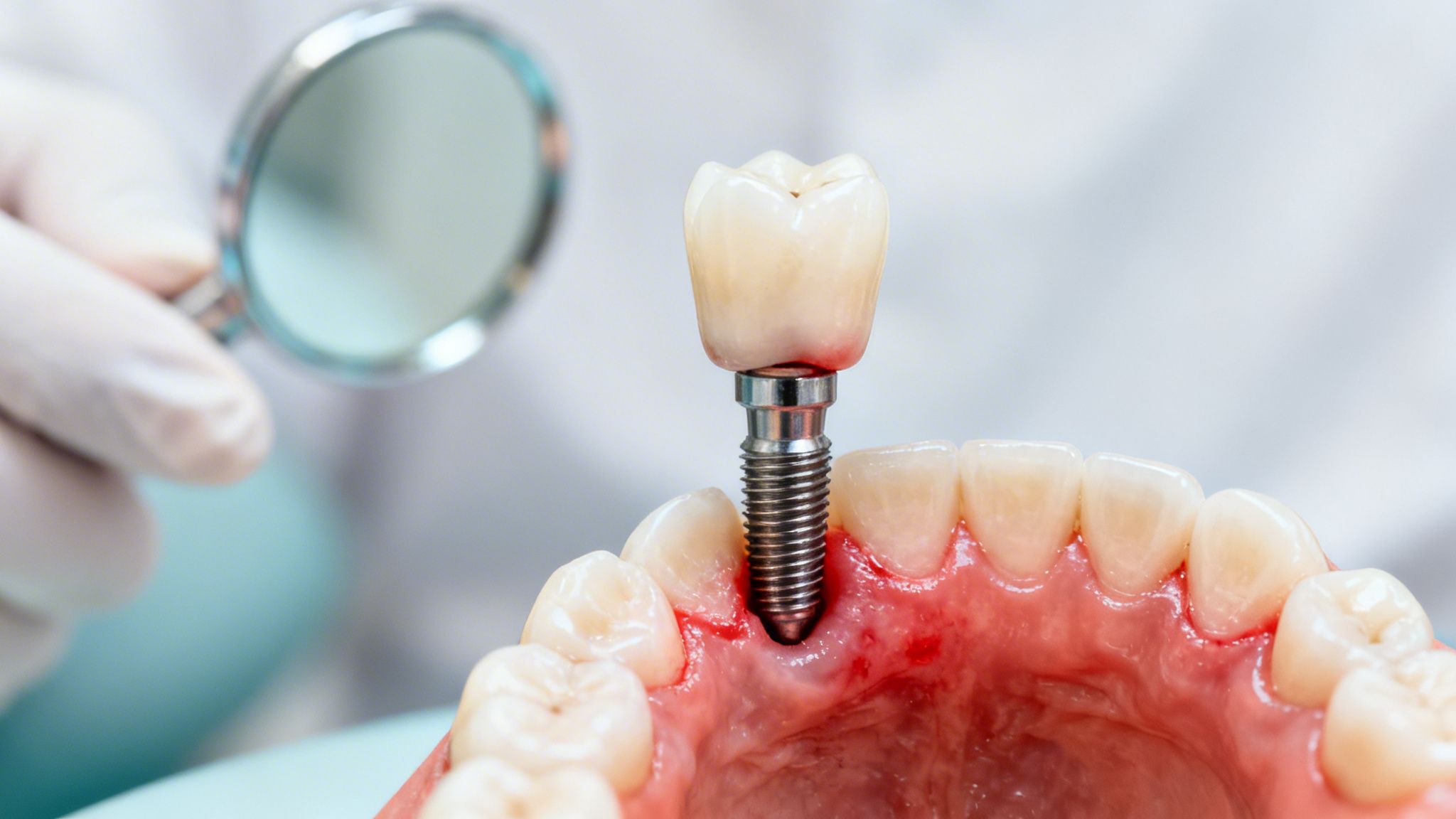
While dental implants have a fantastic track record, it’s smart to know what to watch for once you’re back home. Being able to spot a potential issue early is the best way to protect your investment and your health. Our goal at our Rancho Bernardo office is to empower you with knowledge, not to cause worry.
Think of these signs as your body’s “check engine” light. It’s a signal to get things looked at by your local dentist before a minor problem becomes a major one. If you notice any of the symptoms below, it doesn't automatically mean your implant is failing, but it absolutely means it's time to call us for a professional evaluation.
Pain, Discomfort, Or Bleeding
When something isn’t right with an implant, your body has a way of letting you know. Pain is often one of the clearest signals it can send.
- Persistent Pain or Throbbing: Once fully healed, your implant should feel just like a natural tooth—completely comfortable. Any new or recurring pain, throbbing, or a dull ache around the implant site is a definite red flag.
- Red, Swollen, or Bleeding Gums: Healthy gums around an implant are firm, pink, and don’t bleed when you brush. If you spot puffiness, redness, or bleeding, it could be an early warning sign of peri-implantitis, an infection around the implant.
- Pain When Biting or Chewing: You should be able to eat your favorite foods without giving your implant a second thought. If you feel a sharp pain or a persistent ache when you bite down, it might point to a problem with the implant’s stability or the crown itself.
These symptoms often point to inflammation, and it’s important to know that many of the general signs of gum disease can overlap with implant-specific issues.
A Loose Or Shifting Sensation
A successful dental implant should feel rock-solid—as firm and stable as a healthy, natural tooth. Any feeling of movement, no matter how slight, is a serious sign that needs immediate professional attention.
You might notice this "wiggle" when you're eating, talking, or even just touching the crown with your tongue. This is one of the most critical signs of why do dental implants fail, as it often signals a loss of osseointegration—the crucial bond between the implant post and your jawbone.
Do not ignore even a tiny bit of movement. If your implant or the tooth attached to it feels loose, it's a clear signal that the underlying foundation is compromised. Calling your San Diego dentist right away is essential to figure out the cause and explore how to save it.
Other Important Signs To Watch For
Beyond pain and movement, a few other subtle clues can indicate a problem is brewing.
- Pus or a Bad Taste: Any drainage or a persistent foul taste coming from the implant area is a strong indicator of an active infection that needs to be treated.
- Visible Threads: The metal threads of the implant post should always be hidden beneath your gums. If your gum line recedes enough to expose them, it means significant bone loss has occurred.
- Difficulty Chewing: If you suddenly find it hard to chew on the side with your implant, your body might be instinctively trying to protect a painful or unstable area.
If you are a patient in the Rancho Bernardo, CA, area and notice any of these symptoms, please contact our office immediately. Quick and decisive action is your best bet for addressing the problem, protecting your health, and potentially saving your dental implant.
Your Next Steps For A Healthy Smile in San Diego
Whether you're just starting to explore dental implants or you already have them, we know that building and maintaining a healthy smile is your top priority. The journey to a beautiful, long-lasting result is a partnership, and understanding the risks—like why do dental implants fail—is the first step toward preventing them.
Our Rancho Bernardo practice is a trusted home for patients from all over San Diego, including our neighbors in Poway and Rancho Peñasquitos. We're here to offer clear, comprehensive implant consultations and the dedicated ongoing care you deserve.
What to Expect at Your San Diego Dental Visit
Your visit with Dr. Salami starts with a warm welcome and a complete new patient exam. We’ll take dental x-rays to get a clear picture of your oral health and bone structure, giving us the foundation for a great plan. Most importantly, we take the time to listen to your goals and answer every question you have.
We want you to feel confident and informed. Our team will sit down with you to discuss everything, including:
- Your options for dental implants and other restorative dentistry treatments.
- What to expect from the procedure itself, from placement to your final, beautiful crown.
- A clear and simple plan for long-term care to protect your investment in your smile.
Take The First Step in Rancho Bernardo, CA
Don't let uncertainty stand between you and the confident smile you deserve. Our goal is to provide exceptional dental care for our community, whether you need a routine cleaning and exam, are dreaming of cosmetic dentistry, or need help from an emergency dentist. We are the "dentist near me" you've been looking for.
The most powerful thing you can do for your oral health is to take the first step. A consultation is your chance to get clear answers and create a roadmap for a smile that feels secure and looks incredible.
Ready to move forward? Schedule your consultation at our San Diego, CA, office today. We look forward to meeting you and helping you achieve a beautiful, healthy result.
Frequently Asked Questions About Implant Failure in 2026
It’s completely normal to have a few lingering questions, even after learning about the ins and outs of dental implants. We find that clear, honest conversations are the best way to build trust, so we’ve gathered the questions we hear most often from our San Diego patients. Our goal is to help you feel confident and fully informed as you explore your options.
What Is The Actual Success Rate Of Dental Implants?
This is usually one of the first things people ask, and the answer is incredibly reassuring. Modern dental implants have a proven success rate between 95-98%, making them one of the most reliable and long-lasting treatments in all of dentistry.
Of course, that high success rate isn't a given. It’s the result of a skilled and experienced dentist, top-quality materials, and—most importantly—your commitment to taking care of your new smile. That’s why we always start with a detailed evaluation at our San Diego, CA, office to ensure you’re set up for success right from day one.
Can A Failed Dental Implant Be Replaced?
In the vast majority of cases, the answer is yes. If an implant does happen to fail, our first priority is to figure out exactly why. Dr. Salami will perform a thorough exam, complete with dental x-rays, to get to the root of the issue.
From there, the process is very straightforward:
- Gentle Removal: We carefully remove the failing implant to protect the surrounding bone and gum tissue from any further damage.
- Site Preparation: The area is cleaned, and any infection is fully treated. Often, the site will need a bone graft to rebuild a strong, dense foundation for a future implant.
- Healing Time: We give your jaw several months to heal and integrate with the new bone graft material, ensuring the site is perfectly healthy.
- A Fresh Start: Once we confirm the site is strong, a new dental implant can be placed with a high likelihood of success.
Every situation is different, but replacing a failed implant is a very predictable procedure with the right planning. We create a personalized recovery plan for every patient in our Rancho Bernardo practice to ensure the best possible outcome.
Do I Need To See A Specialist For A Failing Implant?
This is a critical point. While many general dentists place implants, managing a complication requires a much deeper level of experience. It’s essential to see a dentist like Dr. Pegah S. Salami, who has advanced training in every aspect of implant dentistry—from the initial surgery to the final restoration.
Saving a failing implant is often more complex than placing a new one. It involves diagnosing the precise reason why dental implants fail in a specific case, which could involve anything from infection control to intricate bone grafting or bite adjustments. Our Rancho Bernardo, CA, practice is fully equipped to handle these complexities right here, giving you the expert care you need under one roof.
When an implant is in trouble, you need a dentist who not only knows how to place them but also knows how to save them. Dr. Salami's advanced training ensures she can handle complex cases right here in our local community.
How Do I Prevent My Dental Implant From Failing?
The best way to ensure your implant lasts a lifetime is through a partnership between you and your dental team. Your daily habits are the first and most important line of defense.
Think of your implant just like a natural tooth—it thrives on consistent care. Brushing twice a day and flossing daily around the implant crown is key to removing plaque. Tools like water flossers or interdental brushes can make cleaning even more effective.
But home care is only half the equation. Regular professional check-ups at our office are non-negotiable. These visits allow us to perform professional cleanings and exams, monitor the health of the bone and gums around your implant, and check your bite for any subtle changes. Catching potential issues like peri-implantitis early is the absolute key to preventing bigger problems down the road.
Finally, avoiding smoking and managing systemic health conditions like diabetes will give your implant the best possible chance for success.
Ready to take the next step toward a confident, healthy smile? Whether you need a new patient exam or a second opinion on an existing implant, Pegah S. Salami, DMD, FAGD is here to help. Contact our San Diego office today to schedule your consultation.





