

Many adults in San Diego spend months thinking about orthodontic treatment before they ever schedule a visit. They notice a crowded lower front tooth in photos, a gap that shows more during conversation, or a bite that feels off when they chew. Then the practical questions start. Will braces look too noticeable at work? Will Invisalign be enough for my case? What if I already have crowns, gum concerns, or TMJ symptoms?
Those questions are reasonable. Adult orthodontics isn't just about looks. It affects comfort, cleaning, confidence, and long-term oral health. For some patients, the right choice is clear aligners. For others, traditional braces give better control and a more predictable path.
If you're comparing options for a confident San Diego smile, it helps to look at the decision the way a dentist does. Not just which treatment is more popular, but which one fits your teeth, your schedule, and your health history.
Straightening Your Smile as an Adult in San Diego
A lot of adults come in with the same hesitation. They want straighter teeth, but they don't want treatment to disrupt everything else. A professional in Rancho Bernardo may want a more polished smile for presentations and client meetings. A parent in Poway may finally be ready to focus on their own dental care after years of putting everyone else first. Someone in Escondido may be less concerned about appearance and more concerned that shifting teeth are making cleaning harder.
Both Invisalign and braces can be good options for adults. The better choice depends on what you're trying to fix and how you live day to day. If your main concern is discretion and flexibility, clear aligners often appeal right away. If your teeth need more detailed movement, braces may be the more reliable solution.
Adults also bring factors that teenagers usually don't. Existing crowns. Old fillings. Gum recession. Clenching. TMJ discomfort. A history of avoiding the dentist because life got busy. Those details matter, and they can change the treatment recommendation.
For patients who want a starting point before booking, our page on straightening adult teeth gives a helpful overview of what adult orthodontic care can involve.
The key is getting past the idea that there's one universal winner in invisalign vs braces for adults. There isn't. There is only the option that makes the most sense for your mouth, your goals, and the way you need treatment to fit into your life in San Diego.
Comparing Daily Life Aesthetics and Comfort
An adult orthodontic treatment has to fit real life in San Diego. It has to work in meetings, at dinners, during travel, and in the middle of an already busy schedule. For many patients, comfort and visibility affect the decision almost as much as tooth movement.
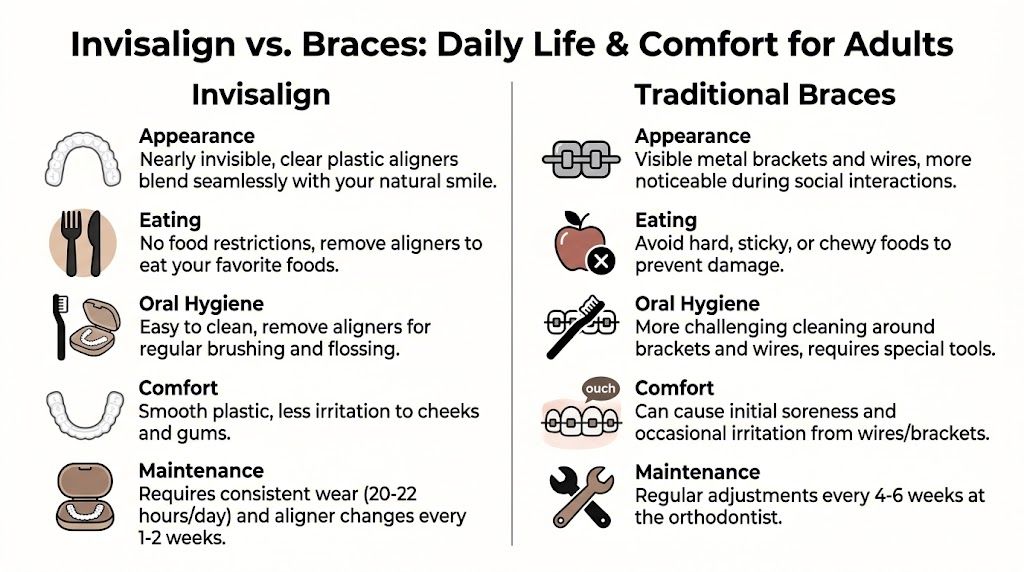
A quick side by side view
| Daily factor | Invisalign | Traditional braces |
|---|---|---|
| Appearance | Clear aligners are designed to be discreet | Brackets and wires are more visible |
| Eating | Remove aligners before meals | Food choices need more caution |
| Brushing and flossing | Remove trays and clean teeth normally | Cleaning around brackets takes more effort |
| Comfort | Smooth plastic tends to feel gentler on cheeks and lips | Brackets and wires may cause irritation |
| Routine | Requires wearing aligners 20 to 22 hours daily | Stays on full time without daily removal |
| Adult preference | Many adults prefer the lower-profile look and removable design | Many adults prefer a fixed option that does not depend on daily compliance |
What adults usually notice first
Adults in client-facing roles often ask the same practical question. Will people notice this before they notice me?
Invisalign usually wins on appearance. The trays are subtle, and that matters for professionals who spend the day speaking, presenting, interviewing, or meeting patients and clients face to face. Many adults tell me they feel more at ease wearing aligners at work because treatment stays in the background.
Braces are easier to see, but visibility is only part of the story. Some adults prefer braces because they are always working. There is no decision to put them back in after coffee, lunch, or a late meeting. For patients with demanding schedules or a history of inconsistent routines, that fixed design can be a real advantage.
Eating, coffee, and everyday routines
The day-to-day difference becomes obvious at meals. Invisalign lets you eat what you normally eat because the aligners come out first. That feels easier for adults who have business lunches, date nights, or family meals where they do not want to worry about food catching around brackets.
Braces need more care with crunchy, sticky, and chewy foods. It is manageable, but it changes habits. Adults who snack between appointments, grab lunch quickly, or eat on the go usually notice that braces require more planning and more cleanup.
Coffee is often the deciding detail. Aligners work well for adults who can finish a drink, clean their teeth, and place the trays back in. They are harder for adults who sip coffee throughout the morning or keep a drink at their desk all afternoon. Braces remove that compliance issue, even if they ask more of you at cleaning time.
Comfort, gums, and jaw tension
Most adults find aligners gentler on the cheeks and lips because there are no brackets or wire ends. There is still pressure with each new set of trays, but it is often easier to tolerate during a busy workweek. Braces can cause sore spots, especially after adjustments, and adults with a lot of speaking commitments tend to notice that quickly.
Comfort is not only about soft tissue. Adults often come in with gum recession, bone loss, clenching, or TMJ symptoms, and those factors can change what feels manageable day to day. A patient with tender gums may appreciate being able to remove aligners for brushing and flossing. A patient with jaw tension may need a plan that considers bite changes carefully rather than choosing the least visible option by default.
That is why adult orthodontics should not be treated like a cosmetic purchase. In our San Diego practice, we look at the condition of the gums, existing restorations, and jaw function before recommending either system, because a treatment that looks convenient on paper may be the wrong fit for an adult with periodontal concerns or joint discomfort.
Oral hygiene and professional confidence
Oral hygiene is often easier with Invisalign because you can brush and floss without working around brackets. For adults with early gum disease, past periodontal treatment, or areas that already trap plaque, that simplicity can make a meaningful difference in how clean the teeth and gums stay during treatment.
Braces demand more technique and more consistency. Some adults do very well with that. Others find that plaque collects faster around the gumline and between brackets, especially during stressful work periods or travel-heavy months.
Professional confidence matters too. Some adults care most about discretion. Others care more about not having to think about treatment during the day. Both concerns are valid. The better choice is the one you can live with comfortably and follow consistently for the full course of treatment.
Clinical Effectiveness for Common Adult Dental Issues
Lifestyle matters, but function matters more. The right orthodontic choice has to move teeth safely and predictably. For adults, the most common concerns are crowding, spacing, relapse after earlier orthodontics, and bite problems that may also contribute to wear or jaw strain.
Where Invisalign does very well
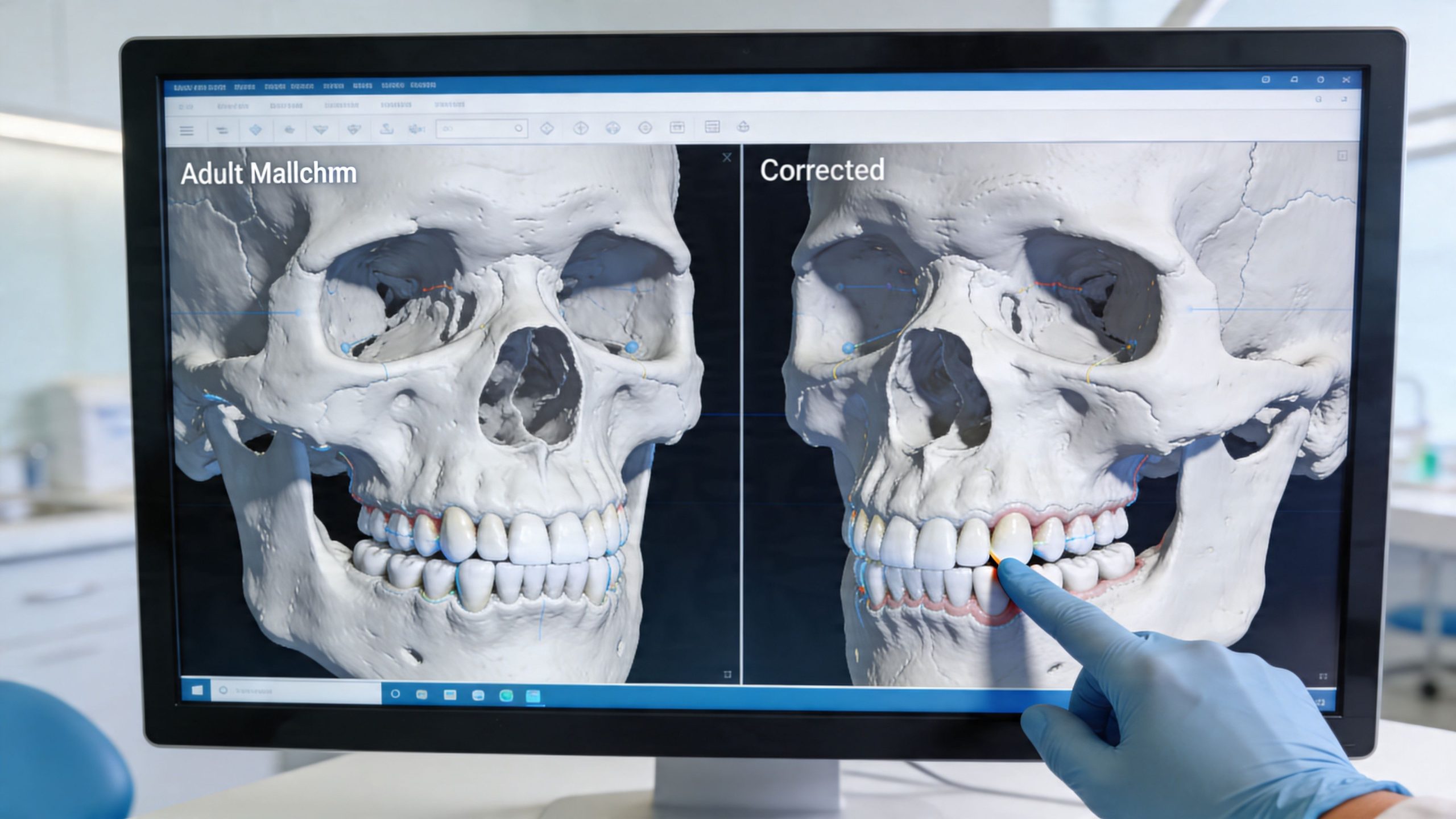
Invisalign is often a strong option for mild to moderate crowding, gaps, and many adult cases where teeth have shifted over time. It can also work well for adults who had braces years ago and now want to correct relapse without going back to a more visible appliance.
Clinical data summarized in a PMC review on Invisalign and braces found a mean treatment time of 18 months for Invisalign versus 24 months for braces, and reported 88 to 90% effectiveness for Invisalign compared with 90 to 91% for braces in malocclusion correction. That tells adults something useful. Invisalign isn't a cosmetic shortcut. In appropriate cases, it is a clinically effective treatment.
When braces usually offer better control
Braces still have an advantage in more complex movement. If teeth need substantial rotation, if the bite problem is more severe, or if movement has to be carefully controlled around restorations and existing wear patterns, fixed brackets and wires often give better precision.
That matters for adults with:
- Complex bite correction where tooth movement has to be directed very specifically
- Significant crowding that may require stronger, continuous control
- Teeth with challenging rotations that don't always respond as predictably to removable trays
- Cases involving compliance concerns, because braces work around the clock without depending on patient wear time
Adults with crowns, bridges, implants, or TMJ concerns
Adults often ask whether previous dental work changes the recommendation. It can. Crowns and bridges don't automatically rule out either option, but they do require more thoughtful planning. Dental implants are different because implants don't move like natural teeth, so treatment has to be designed around them.
TMJ symptoms also deserve attention. Orthodontics can help when bite relationships are part of the problem, but it isn't wise to promise that either Invisalign or braces will automatically solve jaw pain. In practice, adults with TMJ concerns often need a broader plan that looks at bite forces, clenching patterns, restorations, and joint symptoms together.
A straighter smile is valuable, but the bite has to function well too. Good orthodontic treatment doesn't just line up front teeth. It respects how your whole mouth works.
The practical clinical takeaway
For many adults, Invisalign is fully capable of delivering excellent results. For others, braces remain the more dependable tool. The decision shouldn't be based on what looks easier online. It should be based on what your teeth need to move, and how much precision your case requires.
Your Treatment Journey and Timeline at Our San Diego Practice
Most adults feel better once they know what the process looks like. Orthodontic treatment feels less overwhelming when it's broken into clear steps and tied to a realistic timeline.

Step one is a detailed consultation
The first visit starts with an exam, digital imaging, and a conversation about your goals. Adults usually want more than a yes-or-no answer. They want to know whether their case is cosmetic, functional, or both. They also want to know if gum inflammation, worn teeth, old crowns, or TMJ symptoms need attention before orthodontic movement begins.
At this stage, the treatment recommendation becomes clearer. Some patients are obvious Invisalign candidates. Others are better served by braces, or by doing periodontal or restorative care first.
If you're curious about timing, our guide on how long Invisalign takes gives additional context on what can affect the schedule.
What the active phase looks like
For Invisalign, treatment usually begins with digital planning and a series of custom aligners. You'll wear each set in sequence and keep the trays in for 20 to 22 hours a day, removing them for meals and oral hygiene. Success depends heavily on consistency.
Braces follow a different rhythm. Once brackets are placed, they're working continuously. There is no need to remember to put them back in after eating, but there is a bigger adjustment period for cleaning and food choices.
A typical adult experience looks like this:
Consultation and records
We evaluate alignment, bite, gum health, restorations, and overall goals.Case planning
Treatment is mapped out based on the type of movement needed and the best tool for it.Appliance delivery
Aligners are issued or braces are placed. You'll get instructions for cleaning, comfort, and follow-up.Progress visits
These visits let us monitor movement, check oral health, and make adjustments if needed.
Your role matters more with Invisalign
The biggest difference in day-to-day responsibility is compliance. Braces are fixed. Invisalign is removable. That convenience is also the risk. If aligners spend too much time in the case instead of on your teeth, treatment slows down and results become less predictable.
This short video gives a helpful look at how aligner treatment works in practice.
What adults often appreciate most
Adults tend to value clarity. They want to know what appointments will feel like, how treatment fits around work, and whether progress will be obvious. Good planning makes all of that easier.
At our Rancho Bernardo office, that process may also include coordinating orthodontic care with other services already offered in-house, such as periodontal therapy, TMJ treatment, cosmetic dentistry, or restorative dentistry. That can be helpful when straightening teeth is only one part of the bigger picture.
Understanding the Cost of Adult Orthodontics and Insurance
An adult patient usually asks about cost after one practical question. How will this fit into real life, especially if there are work responsibilities, family expenses, or other dental problems to handle at the same time?
For adults in San Diego, Invisalign and braces are often priced closer together than expected. In many cases, the final decision is less about a dramatic fee gap and more about which option fits your oral health, your schedule, and the type of tooth movement your case requires.
What affects the final fee
The fee is shaped by the amount of treatment needed, not just by whether you choose clear aligners or braces.
Several factors usually matter most:
- Case complexity. Crowding, bite correction, relapse after past orthodontic treatment, and jaw strain can all change the amount of work involved.
- Treatment length. Longer cases usually mean more visits, more adjustments, and sometimes refinement stages.
- Pre-existing dental conditions. Adults are more likely to need periodontal care, repair of worn or broken teeth, or TMJ-related evaluation before or during orthodontic treatment.
- Appliance selection. The right tool for your case may influence cost, but the bigger issue is whether it can move teeth safely and predictably.
Notably, adult orthodontics differs from teen treatment in a meaningful way. If gum support is reduced, if teeth have old crowns or fillings, or if bite imbalance is contributing to clenching and joint discomfort, treatment planning has to account for those issues from the start. At our Rancho Bernardo office, that often means coordinating orthodontics with periodontal, restorative, or TMJ care instead of treating tooth alignment as a stand-alone cosmetic service.
Insurance and budgeting questions adults should ask
Dental insurance may help, but the details matter. Some plans cover adult orthodontics. Others exclude it, apply waiting periods, or cap benefits with a lifetime maximum that covers only part of treatment.
Patients should confirm a few basics before starting:
- Whether adult orthodontic benefits are included
- Whether Invisalign is covered differently than braces
- Whether there is a waiting period
- Whether there is a lifetime orthodontic maximum
- Whether pretax funds such as HSA or FSA dollars can be used
Some adults also review broader financial protection if they expect a year with several healthcare expenses. If that applies to you, this overview of supplemental health insurance coverage explains how those plans work in general.
A good financial conversation should feel clear, not rushed.
When patients call our San Diego practice, we encourage them to ask for a benefits review before treatment begins. That helps avoid surprises and gives a more accurate picture of out-of-pocket cost, monthly payment options, and how orthodontic care fits into the rest of their treatment plan.
Adult orthodontics is usually a planned investment in function, health, and confidence. The best value comes from choosing the option that fits your clinical needs and your daily life, then setting up a payment plan that makes sense.
For many adults, the better question is not, “Which costs less?” The better question is, “Which option solves the problem well, supports long-term gum and bite health, and works for my professional and personal life?” That is usually how a confident San Diego smile is built.
Long-Term Health Benefits and Post-Treatment Retention
Finishing treatment feels like the end, but it isn't the last step. The long-term result depends on retention and on how well your gums and supporting bone stay healthy during and after tooth movement.
Retainers are not optional
Teeth can shift after orthodontic treatment. That's true whether you choose Invisalign or braces. Once teeth have moved into a better position, retainers help hold that result while the surrounding tissues stabilize.

Some adults assume their teeth will stay put once treatment is done. They usually won't. Retainer wear protects the time, money, and effort you've already invested.
Why gum health changes the conversation for adults
This part is especially important for adults because gum concerns become more common with age. A summary discussing a 2022 PMC study reported that clear aligners showed a plaque index of 1.2 compared with 1.8 for braces, along with reduced gingival inflammation and lower oral bacterial counts, and noted that 40 to 50% of U.S. adults over 30 have some form of periodontal disease in the discussion provided by Smile Now Dentistry.
That doesn't mean Invisalign is automatically the right answer for every adult with gum issues. It does mean removability can be a meaningful advantage when plaque control is a concern.
A realistic view for adults with pre-existing periodontal issues
Adults with periodontitis, recession, or chronic inflammation need careful sequencing. Sometimes the first step isn't orthodontics at all. It's periodontal therapy, a professional cleaning plan, and getting the gums stable enough for tooth movement.
A practical way to consider:
- If cleaning access is the main challenge, aligners may support better daily home care.
- If compliance is likely to be inconsistent, braces may keep treatment moving but can make hygiene harder.
- If gum support is already reduced, the entire plan has to be conservative and closely monitored.
Straight teeth look better, but healthy gums keep those teeth for the long haul.
Stability means more than straight front teeth
Long-term success isn't just about whether the smile looks straight five years later. It also includes whether biting feels balanced, whether cleaning is easier than before, and whether inflammation stayed under control during treatment.
That's where adult care benefits from an integrated approach. Orthodontics, periodontal maintenance, restorative planning, and retainer follow-through all connect. If one piece is ignored, the final result is harder to protect.
Which Is Right for You Invisalign or Braces
The simplest answer is that the right treatment is the one that matches both your clinical needs and your daily habits. Adults usually do best when the recommendation fits the reality of their life, not just the ideal version of it.
Invisalign may fit you better if
You might lean toward Invisalign if you're a working adult in Rancho Bernardo, Poway, or greater San Diego who wants a low-profile option and can stay disciplined with wear time. Adults in professional settings often prefer aligners because they can smile, talk, and meet with people without feeling like treatment is taking over their appearance.
It can also be a strong choice if your case is on the mild to moderate side and you value easy brushing and flossing. Adults with a history of gum irritation often appreciate that part of aligner treatment.
Braces may fit you better if
Braces are often the better call when the case is more complex or when remembering to wear aligners consistently would be a struggle. Some adults know themselves well enough to say, “If I can remove it, I probably won't wear it enough.” That's useful information, not a failure.
Braces can also make more sense if the bite needs tighter control or if tooth movement has to be more exact from the start.
A practical self-check
Ask yourself these questions:
- How important is discretion at work or socially?
- Will I wear aligners as directed every day?
- Do I have gum issues that make easier cleaning a priority?
- Is my case simple, or does it involve more complex bite correction?
- Do I want flexibility, or do I want a fixed system that removes that responsibility?
The real decision point
Online research can narrow the options, but it can't replace an exam. Adults often have details that don't show up in generic comparison articles, such as uneven wear, crowns, implants, recession, or TMJ symptoms. Those details can completely change which option makes the most sense.
If you're searching for a cosmetic dentist near me, a dentist near me, or a dentist in San Diego, CA because you want straighter teeth and a healthier bite, the next step isn't guessing. It's getting a personalized evaluation that looks at the whole picture.
Frequently Asked Questions About Adult Braces and Invisalign
Can I get orthodontic treatment if I already have crowns, bridges, or implants
Yes, in many cases you can. Crowns and bridges don't automatically prevent treatment, but they do affect planning. Implants are different because they don't move like natural teeth, so your treatment has to be designed around them.
Will the first week hurt
Most adults feel pressure and soreness at the beginning, whether they start with aligners or braces. With Invisalign, the pressure is often most noticeable when switching to a new tray. With braces, soreness and irritation can happen after placement and after adjustments. Soft foods, good hydration, and following office instructions usually make the first week easier.
Is there a difference in retainers after Invisalign and braces
The retainer design can vary, but the principle is the same. You need a retainer to keep teeth from shifting after treatment. Some patients use clear removable retainers. Others may need a fixed retainer in selected areas. The right option depends on how your teeth moved and how stable the result is expected to be.
What happens if I lose an Invisalign aligner
Call the office as soon as possible. Depending on where you are in treatment, you may be told to wear the previous tray, move to the next one, or wait for a replacement. The right answer depends on how long the tray has been missing and how your teeth are tracking.
Can adults with gum disease still choose Invisalign
Sometimes, yes, but active gum disease should be addressed first. Orthodontic movement works best when the gums and bone are healthy enough to support the teeth. Adults with periodontal concerns often need coordinated care rather than starting straightening treatment right away.
Can orthodontics help with TMJ problems
It can help in some cases when bite alignment is contributing to strain, but it isn't a guaranteed cure for every TMJ problem. Jaw symptoms often involve several factors, including clenching, muscle tension, joint health, and tooth wear. A careful exam matters.
Do I need a general dentist involved if I want straighter teeth
Yes, especially as an adult. Orthodontics works best when it is coordinated with routine dental care, cleaning and exams, dental x-rays, and any restorative needs such as fillings, crowns, bridges, or even dental implants near me searches that eventually lead to broader treatment planning.
Begin Your Smile Transformation in Rancho Bernardo Today
A straighter smile can absolutely happen in adulthood. The better question is how to do it in a way that supports your health, your schedule, and your confidence. For some patients, Invisalign is the cleaner fit. For others, braces offer the control their case needs. Both can be worthwhile when the plan is thoughtful.
Adults in Rancho Bernardo, Rancho Peñasquitos, Poway, Escondido, and nearby San Diego communities often come in thinking they need a quick yes-or-no answer. What they usually need is a careful evaluation that considers alignment, bite, gum health, existing dental work, and the way treatment will fit into daily life.
If you're also thinking about related care, that visit can connect the dots across cosmetic dentistry, restorative dentistry, TMJ treatment, periodontal therapy, teeth whitening, new patient exams, cleaning and exams, emergency dentist concerns, or even whether a tooth extraction needs to be addressed before orthodontics begins.
One practical option for adults comparing treatment is Pegah S. Salami, DMD, FAGD, where patients can be evaluated for Invisalign, braces, and related dental needs within a full-service San Diego practice.
The right plan should leave you with more than straighter teeth. It should leave you with a smile that feels easier to maintain, more comfortable to use, and more natural to share.
If you're ready to talk through invisalign vs braces for adults with a local team that understands the trade-offs, schedule a consultation with Pegah S. Salami, DMD, FAGD. The office welcomes patients from Rancho Bernardo, Rancho Peñasquitos, Poway, Escondido, and nearby San Diego communities, and can help you explore orthodontic care along with exams, cosmetic options, restorative treatment, and long-term oral health planning.





