
If you’re looking in San Diego for a faster way to straighten the teeth that show when you smile, you’re probably balancing real-life timing with real-life concerns. Maybe there’s a wedding coming up, a new job, more photos with family, or you’ve reached the point where you’re tired of noticing the same front-tooth crowding every morning. For many adults in Rancho Bernardo, Poway, Rancho Peñasquitos, and Escondido, the biggest obstacle isn’t wanting a better smile. It’s not wanting years in braces to get there.
That’s where six month braces can make sense.
This treatment is built for patients who want noticeable cosmetic improvement without committing to full orthodontics when they don’t need it. It isn’t the right solution for everyone, and that’s exactly why it deserves a clear, honest explanation. The best outcomes happen when the goal is well defined, the case is appropriate, and the plan includes what happens after the braces come off.
Patients who search for a dentist in San Diego, CA, a cosmetic dentist near me, or even the best dentist in Rancho Bernardo, CA often want more than a quick answer. They want to know what works, what doesn’t, what the trade-offs are, and how to protect their results long term. That’s the standard a modern cosmetic dentist should meet.
Your Guide to a Straighter Smile with Six Month Braces
You may be getting ready for a wedding in La Jolla, updating your headshots for work, or wanting to stop noticing the same crowded front tooth every time you catch your reflection. In that situation, the question usually is not whether a straighter smile would help. The question is whether you can improve it without signing up for years of treatment.
Six month braces were developed for that kind of goal. They focus on the teeth that show when you smile, so treatment can be shorter and more targeted than full orthodontic care in the right case. For many adults in San Diego, that makes the process feel practical enough to start.
That said, speed only helps if the case selection is right.
In my practice, the best candidates are patients who want cosmetic improvement of the front teeth and understand the limits of short-term orthodontics. If the bite needs significant correction, if the back teeth are part of the problem, or if the teeth have already relapsed after past orthodontic treatment, the plan has to account for that from day one. A shorter treatment plan does not eliminate the need for diagnosis, healthy gums, or a retention strategy after the braces come off.
That last point gets missed far too often. Adults who choose short-term braces are often treating crowding that returned after earlier orthodontics or years without consistent retainer wear. Straightening the smile again can be done efficiently, but keeping it straight depends on what happens next. Retainers are not an afterthought. They are part of the treatment.
Patients often choose this option because they want visible improvement that fits real life. Some want to align the front teeth before whitening or cosmetic bonding. Others want to feel more at ease in meetings, photos, and everyday conversations around Rancho Bernardo, Poway, and the rest of North County. If you are weighing the pros and cons, it helps to compare adult teeth straightening options before deciding which approach matches your goals, timeline, and willingness to wear retainers long term.
A better smile can come faster. Lasting results still require a careful plan.
What Exactly Are Six Month Braces
Six month braces are a fixed cosmetic orthodontic system that uses clear or tooth-colored brackets and light wires to straighten the teeth that show most when you smile. In practice, that usually means the front teeth, not a full reworking of the bite from back molar to back molar.

For many adults in San Diego, that distinction matters. They are not looking for a long orthodontic process to correct every tooth position. They want to improve the visible part of the smile before a wedding, a job change, more professional headshots, or because they are tired of seeing crowding in photos.
What the system is made of
The braces themselves are bonded to the teeth, so they stay in place and work continuously. The brackets are usually ceramic, which makes them less noticeable than traditional metal brackets. The archwires are selected to produce gentle, controlled movement, and the hardware is chosen with appearance in mind because these cases are often adult cosmetic cases.
That does not make them a shortcut. It makes them a targeted orthodontic tool.
What they are designed to correct
Six month braces are meant to improve visible alignment problems in the front of the smile. Common examples include:
- Mild to moderate crowding in the front teeth
- Small gaps between front teeth
- Rotations that make a tooth look twisted or uneven
- Minor leveling issues along the smile line
- Front-tooth positions that have shifted after past orthodontic treatment
I often explain it this way to patients in Rancho Bernardo. If the main complaint is, “I don’t like how these front teeth look,” this can be a very good option. If the complaint is, “My whole bite feels off, I can’t chew well, and my back teeth don’t fit together,” we usually need a different plan.
What they are not designed to do
These braces are not meant for every orthodontic problem. They do not reliably solve significant bite discrepancies, major jaw relationship issues, or complex tooth movement involving the back teeth. They also are not the right choice for patients with untreated gum disease, active decay, or expectations that do not match what short-term orthodontics can realistically deliver.
That case selection is part of doing the treatment well.
A shorter cosmetic case still needs a full diagnosis. I check the health of the gums and bone, look at the bite, review any old orthodontic history, and ask a question many patients have not been asked before. Why did the teeth move in the first place? If relapse caused the crowding, the retention plan after treatment matters just as much as the braces themselves.
Why this option appeals to adults
Fixed short-term braces sit in a useful middle ground. They move natural teeth rather than masking them with veneers or bonding alone, and they do it with less visual impact than older metal braces. For adults who want meaningful cosmetic improvement and are willing to wear retainers after treatment, that balance makes sense.
The key is choosing the right goal from the start and having a clear plan to keep the result stable once the braces come off.
How Accelerated Orthodontic Treatment Works Safely
The safest way to think about accelerated orthodontics is this. The treatment isn’t faster because the braces push harder. It’s faster because the case is carefully selected and the goal is limited to the front teeth.
The role of light-force mechanics
According to this clinical explanation of Six Month Smiles mechanics, the system uses specialized nickel-titanium wire technology with light force mechanics. The shorter timeline is achieved through strategic case selection and a focus on anterior teeth, not through aggressive force.
That matters.
When orthodontic movement is too aggressive, the risks go up. The same source explains that light-force treatment helps prevent the tissue damage and root resorption risks associated with harsher tooth movement. In plain language, the system is built to move teeth gently and steadily toward a cosmetic goal.
Why speed doesn’t automatically mean more discomfort
Patients often ask whether six month braces hurt more because they move faster. In appropriate cases, that isn’t the right way to frame it. A focused treatment plan with low-force wires can feel more manageable than people expect because the braces are not trying to produce broad, complex changes throughout the entire mouth.
Comfort still depends on the individual. Some soreness is normal with any orthodontic movement, especially after placement or adjustments. But the biology of this treatment is based on controlled, gradual movement.
Who this approach works best for
Safe accelerated treatment depends on honest case selection. That means the strongest candidates usually have:
- Mild to moderate cosmetic concerns affecting the front teeth
- Healthy gums and teeth that can support orthodontic movement
- Realistic goals centered on appearance rather than total bite correction
- Commitment to follow-up care and retainer wear after treatment
Patients with more complex needs deserve a different recommendation. That’s not a sales problem. It’s good dentistry.
A short treatment plan only works well when the diagnosis is thorough. The braces may be short term, but the planning cannot be.
This is one reason many adults searching for a cosmetic dentist near me or a dentist near me benefit from a consultation that looks at the whole picture, including cleaning and exams, dental x-rays, gum health, and any restorative needs that should be handled before orthodontic movement begins.
Are You a Good Candidate for Six Month Braces
The best six month braces cases are usually straightforward from a cosmetic standpoint. The front teeth are crowded, spaced, or slightly out of line, but the patient doesn’t need a full orthodontic correction from molar to molar.
Signs you may be a strong fit
You may be a good candidate if your concerns sound like these:
- “My front teeth look crowded in photos.”
- “I have small spaces in the front that bother me.”
- “I want a cosmetic improvement, not years of braces.”
- “I want fixed treatment because I don’t trust myself with removable aligners.”
This option is often appealing to adults and older teens who want visible improvement without the visual impact of metal braces or the commitment of full treatment.
When six month braces are not the right choice
This part matters just as much. Guidance on candidacy and limitations notes that the system does not change a patient’s skeletal jaw relationship, that approximately 20% of potential cases may be unsuitable, and that patients under 16 are typically ineligible due to incomplete root development.
That means six month braces may not be the right fit if you have:
- A significant bite problem that needs complete correction
- Jaw relationship issues that affect how the teeth function together
- Posterior problems involving teeth that aren’t part of the cosmetic front-tooth focus
- A younger age with ongoing development, since this treatment is generally for older teens and adults
A patient can still want fast treatment and not be a safe candidate for it. That’s common, and it’s why a proper exam matters.
Comparing common options by decision criteria
Some patients are deciding among six month braces, Invisalign, and traditional braces. A simple way to think about it is to match the tool to the goal.
| Decision factor | Six month braces | Invisalign | Traditional braces |
|---|---|---|---|
| Main strength | Cosmetic front-tooth alignment | Discreet removable treatment | Broad comprehensive correction |
| Appearance | Clearer, less noticeable than metal | Very discreet | Most visible |
| Patient responsibility | Lower, because braces stay on | Higher, because trays must be worn as directed | Lower, because braces stay on |
| Best for | Mild to moderate cosmetic cases | Many patients who want removability | More complex orthodontic needs |
| Limitation | Doesn’t fix every bite issue | Depends heavily on compliance | Longer treatment commitment |
Some patients love the convenience of fixed braces. Others strongly prefer clear aligners because they can remove them for meals and important events. Others need traditional braces because the scope of treatment is larger than a cosmetic front-tooth adjustment.
For a closer look at how these choices compare, watch this overview before your consultation:
Six Month Braces vs Invisalign and Traditional Braces
Patients usually don’t choose orthodontic treatment based on one factor. They compare speed, appearance, comfort, cost, and how much correction they need. That’s the right approach.
A common patient journey starts with a call to a Rancho Bernardo dental office asking a simple question: “I want straighter teeth, but I don’t want the wrong treatment.” From there, the decision gets more specific. If the concern is mostly the visible front teeth, six month braces may rise to the top. If discretion matters most and the patient is reliable with removable trays, Invisalign may make more sense. If the bite is more involved, traditional braces often remain the most complete option.
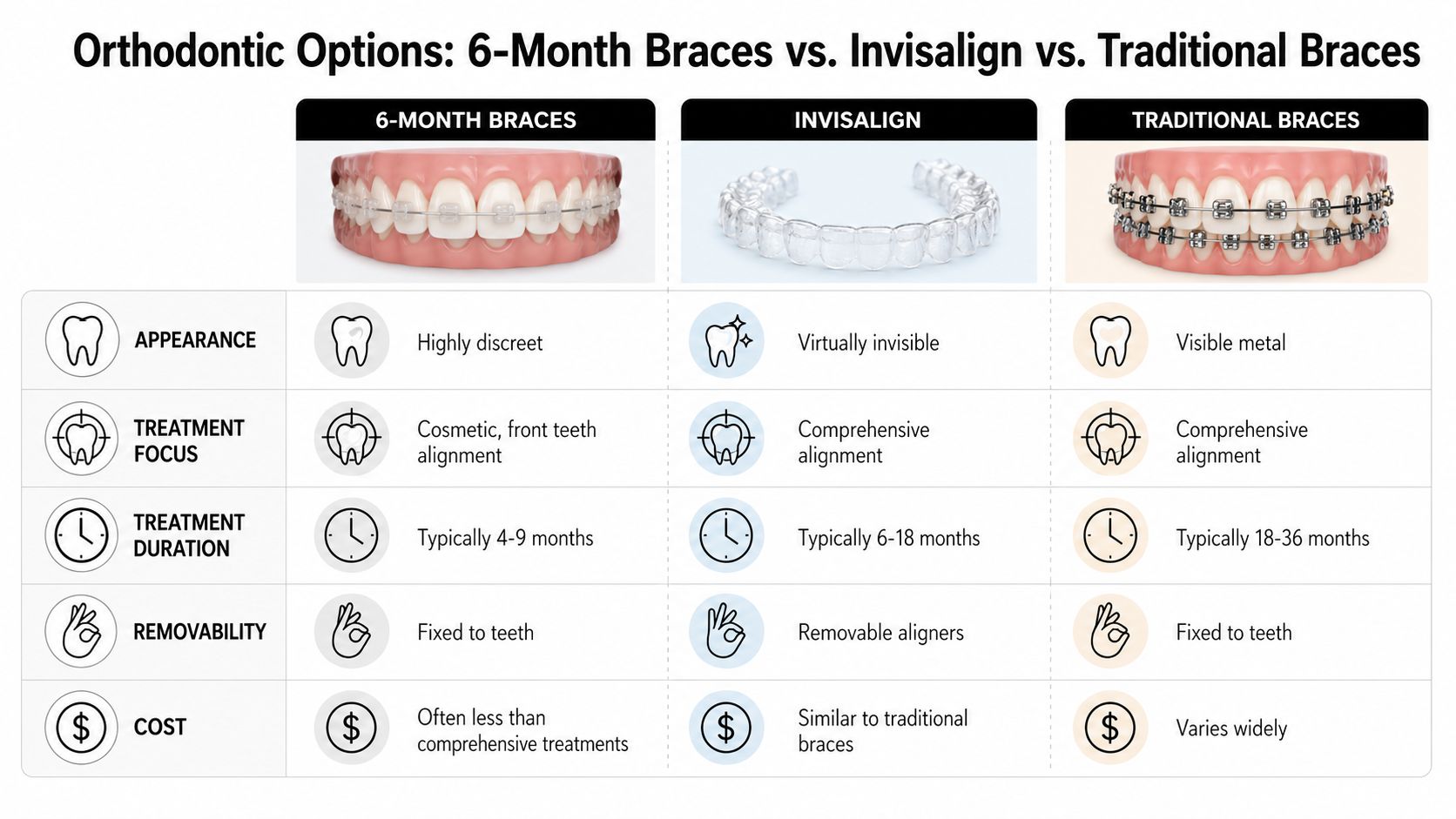
Orthodontic treatment comparison
| Feature | Six Month Braces | Traditional Braces | Invisalign |
|---|---|---|---|
| Treatment focus | Cosmetic alignment of visible front teeth | Comprehensive tooth and bite correction | Broad alignment treatment for many cases |
| Appearance | Clear ceramic brackets and tooth-colored wires | Visible metal brackets and wires | Clear removable aligners |
| Removability | Fixed to teeth | Fixed to teeth | Removable |
| Best fit | Mild to moderate cosmetic concerns | More complex orthodontic problems | Patients wanting a discreet removable option |
| Follow-through style | Office-managed because braces stay on | Office-managed because braces stay on | Strongly dependent on daily patient wear |
How the trade-offs feel in real life
Six month braces often appeal to adults who want a focused cosmetic result and don’t want to keep track of aligner trays. They’re fixed in place, so treatment doesn’t depend on remembering to put them back in after coffee, lunch, or a meeting.
Traditional braces remain the workhorse option when the case is bigger than aesthetics alone. If the back teeth, bite, or jaw relationship need more extensive correction, traditional braces offer a wider treatment scope.
Invisalign suits patients who want a cleaner look and like the flexibility of removable aligners. The upside is discretion. The downside is that success depends more heavily on consistency.
Some patients don’t need the “best” orthodontic option in general. They need the best one for their specific smile, schedule, and habits.
If you’re weighing those differences, this side-by-side guide to Invisalign vs braces can help clarify which trade-offs matter most to you before you book an exam.
Your Treatment Journey at Our Rancho Bernardo Practice
A six month braces case should feel organized from the start. Patients usually do best when each visit has a clear purpose and they know what happens next.
The first appointment
The process begins with a new patient exam, dental x-rays, and a conversation about goals. If someone says, “I don’t care about moving every tooth. I just want the front of my smile to look better,” that’s a useful starting point. The exam then confirms whether that goal is realistic and healthy.
This visit also checks for issues that need attention before orthodontics begins. Active decay, gum inflammation, or restorative concerns may need to be treated first. In a full-service office, that can include cleaning and exams, periodontal therapy, or restorative dentistry before braces are placed.
Planning and placement
Once the case is confirmed as appropriate, the braces are placed and the patient gets instructions on brushing, flossing, and food choices. Because this is a short-term cosmetic system, the plan is narrow and intentional. Every movement should support the visible smile outcome.
Follow-up visits are usually simpler than patients expect. Adjustments are focused on tracking progress, making small refinements, and making sure the teeth are moving as planned.
Patients are often surprised by how manageable the process feels once they understand the goal. The braces are visible up close, but they don’t dominate the smile the way many people fear.
The finish matters as much as the start
The day the braces come off is exciting, but it isn’t the end of treatment. It’s the start of maintenance. Final polishing, photos, and retainer planning are what protect the cosmetic result you just invested in.
That long-view mindset is part of good dental care. A smile that looks better for a few months isn’t the primary goal. A smile that stays stable is.
For patients in Rancho Bernardo, Poway, Rancho Peñasquitos, and Escondido, this kind of coordinated process can also fit naturally with other cosmetic or restorative plans, including teeth whitening, bonding, veneers, or future restorative dentistry after alignment is complete.
Understanding the Cost and Value of a Faster Smile
Cost matters because orthodontic treatment is both a health decision and a financial decision. Patients deserve a direct answer.
This overview of Six Month Smiles costs and candidacy states that the average cost is $3,000 to $4,500, often 20% to 40% less than full braces, and that the system serves patients aged 16 and up. That lower range is tied to the treatment’s shorter duration and fewer adjustments.
Why the fee is often lower than comprehensive orthodontics
Six month braces are usually more affordable because the treatment is narrower in scope. You’re not paying for the same level of full-mouth orthodontic correction that traditional braces are built to provide. The number of visits is typically lower, the timeline is shorter, and the treatment objective is cosmetic front-tooth alignment.
That doesn’t mean the treatment is “cheap.” It means the treatment is targeted.
What patients are really paying for
The value comes from a few practical advantages:
- Speed. A shorter timeline fits better for adults with busy schedules.
- Focused results. The treatment addresses the most noticeable aspects of the smile.
- Fewer adjustments. Less time in treatment often means fewer interruptions to work and family life.
- A confidence upgrade. Cosmetic changes to the front teeth can affect how a patient feels every day.
Financing and payment planning often make the decision easier, especially when the office also offers an affordable new patient exam, x-ray, and cleaning special. For patients searching online for a dentist near me or a best dentist in Rancho Bernardo, CA, that kind of transparency usually matters as much as the fee itself.
The value question patients should ask
The right question isn’t only, “How much does this cost?”
It’s also, “Does this treatment match my goal well enough to be worth it?”
If the answer is yes, six month braces can be one of the most efficient cosmetic dentistry investments a patient makes.
Ensuring Your New Smile Lasts a Lifetime
Short-term orthodontics only works long term if retention is taken seriously. Teeth move. That’s normal biology, not treatment failure.
Why relapse deserves attention
This discussion of six-month braces and retention concerns notes that there is no specific relapse data for six-month braces, but general orthodontic principles show that any tooth movement requires diligent retention. The same source adds that relapse can affect up to 50% to 70% of cases without proper retainer use.
That point gets skipped too often in cosmetic discussions. Patients hear about the faster smile, but not always about the maintenance that protects it.
Key takeaway: The braces move the teeth. The retainer helps keep them there.
What retention usually involves
Retention is individualized, but it commonly includes one or both of these approaches:
- Removable retainers that are worn on a set schedule after treatment
- Fixed retainers bonded behind certain teeth when extra stability is needed
The right choice depends on the alignment achieved, the position of the front teeth, and how likely the patient is to keep up with a removable appliance.
What helps results stay stable
A lasting result usually comes down to habits. The most important ones are simple:
- Wear the retainer exactly as directed.
- Keep up with regular dental visits and cleanings.
- Report changes early if teeth start to shift.
- Replace damaged or lost retainers quickly.
A good cosmetic dentist proves value after the braces come off. Long-term support matters. So does honest follow-up if a patient notices movement months or years later.
For many San Diego patients, that long-view approach is what turns a cosmetic improvement into a lasting part of their overall dental care.
Your Questions About Six Month Braces Answered
Is the treatment painful
Most patients describe six month braces as manageable. You can expect pressure and some soreness when the braces are first placed and after certain adjustments, but the system uses light-force mechanics rather than aggressive movement. Soft foods and a little patience usually help during the first few days.
Will the brackets stain my teeth
The brackets themselves don’t stain enamel, but plaque around braces can create problems if brushing and flossing slip. Tooth-colored components can also pick up discoloration if oral hygiene is poor or if someone frequently consumes staining foods and drinks without cleaning well afterward. Good home care and regular professional cleanings make a big difference.
Can I still get regular dental cleanings
Yes, and you should. Professional cleanings are important during any orthodontic treatment because braces create more areas where plaque can collect. Many patients do well when they stay consistent with cleaning and exams throughout treatment instead of waiting until the braces come off.
What happens if a bracket comes loose
Call the dental office. A loose bracket isn’t always an emergency, but it does need attention because it can affect how the teeth move. Don’t try to fix it yourself. You’ll be told whether you should come in right away or whether it can wait briefly until the next available visit.
Are six month braces better than Invisalign
Not across the board. They’re better for some patients and worse for others. If you want fixed treatment, have mild to moderate cosmetic concerns in the front teeth, and like the idea of a focused plan, six month braces can be a strong option. If you want something removable and highly discreet, Invisalign may fit better. If your case is more complex, traditional braces may be the safer recommendation.
Can I combine six month braces with cosmetic dentistry
Often, yes. Some patients straighten first and then refine the smile with whitening, bonding, or veneers. That sequence can be smart because it improves tooth position before any final cosmetic shaping or color matching is done. A complete exam helps determine what order makes the most sense.
Is this an option if I also need restorative work
Sometimes, but planning matters. If you need crowns, fillings, implants, or other restorative dentistry, the sequence should be coordinated carefully. In some cases, alignment comes first. In others, dental health issues need to be stabilized before braces begin. A full-service office can help map that out clearly.
Should I wait if I’m also dealing with a dental problem
If you’re in pain, have swelling, or think you may need urgent care, handle that first. Orthodontic treatment should start from a healthy baseline whenever possible. Patients looking for an emergency dentist, tooth extraction, dental implants near me, or other restorative care often benefit from solving the immediate problem first and planning smile improvement after that.
If you’re considering six month braces and want a clear, honest evaluation of whether they’re the right fit, Pegah S. Salami, DMD, FAGD offers patient-focused cosmetic and family dental care in San Diego’s Rancho Bernardo area. Whether you’re comparing short-term braces, Invisalign, whitening, veneers, or restorative options, the team can help you understand your choices and build a plan that fits your smile, schedule, and long-term goals.





