

If your denture shifts when you chew, lifts when you talk, or forces you to think about every bite before you take it, you’re not imagining the problem. Loose dentures can turn ordinary moments into stressful ones. Dinner with family feels risky. A work conversation feels distracting. Even laughing can come with a quick check to make sure everything still feels secure.
That’s why so many people in San Diego search for answers like denture suction cup, stronger adhesive, or “best dentist near me” when their denture stops feeling dependable. The good news is that a stable denture usually isn’t about gimmicks. It’s about understanding why dentures loosen, what creates retention, and which modern options give you a better long-term result.
Struggling with Loose Dentures in San Diego
A lot of new patients describe the same pattern. They were managing well enough at first. Then meals became harder. Toast, salad, or anything that needed real chewing started to feel unpredictable. Speaking clearly took more effort. Social situations got tiring because they were paying attention to their denture instead of enjoying the moment.
In a community like Rancho Bernardo, where people stay active and social, that frustration adds up fast. You should be able to enjoy lunch with friends, have a conversation without second-guessing your speech, and smile without worrying that your denture will shift.

What loose dentures often feel like day to day
For many patients, the problem isn’t just one dramatic slip. It’s the constant low-level irritation that wears on confidence.
- At meals: Food gets trapped underneath, chewing feels uneven, or the denture lifts at the back.
- While speaking: Certain words feel harder to pronounce, especially if the denture moves when the tongue presses against it.
- At home: Adhesives become part of the daily routine, but the result still feels inconsistent.
- Emotionally: People stop choosing favorite foods and start avoiding situations where they feel self-conscious.
Loose dentures don’t just affect your mouth. They affect how relaxed you feel in your own life.
Patients looking for a denture dentist near me or the best dentist in Rancho Bernardo, CA usually aren’t asking for perfection. They want something more basic and more important. They want reliability.
Why this deserves a professional evaluation
A denture that no longer fits well usually means something has changed. Sometimes the denture itself has worn. Sometimes the shape of the gums and jaw has shifted over time. Sometimes the original fit was never ideal in the first place.
That’s why a real exam matters more than another over-the-counter fix. At a local Rancho Bernardo dental office, the goal should be to identify the reason the denture is unstable and match it with the right solution, whether that means adjustment, reline, replacement, or a more secure restorative option.
The Real Science of Denture Suction
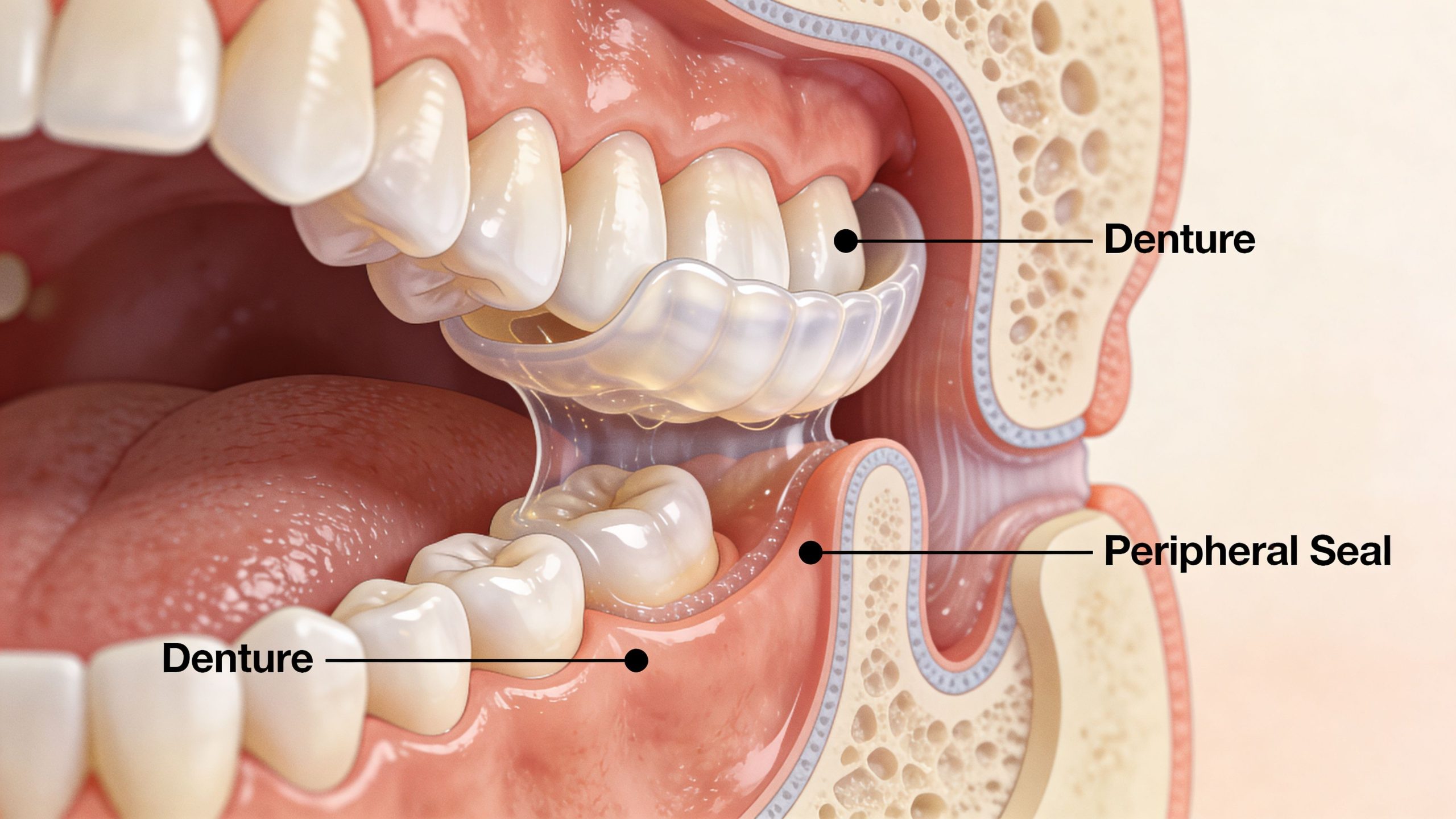
The phrase denture suction cup sounds simple, but it often gives patients the wrong picture. Modern denture retention usually does not come from tiny cups attached to the denture. It comes from a precise fit, a continuous border seal, and the thin layer of saliva between the denture and the oral tissues.
What creates real suction
A simple way to think about it is two smooth wet surfaces pressed together. They resist separation better than dry, uneven surfaces. Dentures work on a similar principle when the shape of the denture matches the tissues closely and the edges form a stable seal.
Several factors work together:
- An accurate denture base: The denture has to match the contours of your mouth closely.
- A good peripheral seal: The borders need to follow the natural edges of the tissues without overextending or falling short.
- Saliva: A healthy saliva layer helps create the surface tension that supports retention.
- Balanced bite forces: If the bite is off, the denture can rock and break the seal.
When those details are right, the denture can feel much more secure without relying on a literal suction cup design. If you want a patient-friendly explanation of this principle, this guide on how dentures stay in place is a helpful companion.
Where the suction cup idea came from
The idea itself is old. The concept of using suction cups for denture retention dates back to a U.S. patent filed in 1885 by Dr. J. Spyer and R.S. Ingalls. While advanced for its era, this 19th-century technology has been superseded by modern techniques that rely on precise anatomical fit and material science for superior, healthier results, as discussed in Dentistry Today’s review of suction cup denture history.
That history matters because it explains why the term still shows up online. Patients hear “suction” and assume the answer must be some kind of add-on device. In practice, the better answer is usually a carefully made denture that works with your anatomy instead of pressing against it in the wrong way.
Here’s a short visual explanation that helps many patients understand the difference between old ideas and modern fit principles.
Practical rule: If a denture only feels stable when you keep adding products to it, the fit deserves a closer look.
Why precision matters more than products
A denture can only perform as well as its fit allows. If the tissue surface is inaccurate, or if the borders don’t seal correctly, no cream, pad, or gimmick will reliably solve the problem. This is why patients who search for a dentist near me after trying store-bought fixes often end up needing a clinical adjustment rather than a stronger accessory.
Risks of Aftermarket Denture Suction Cups
People usually don’t search for a denture suction cup because they’re curious. They search because they’re frustrated. Their denture moves, meals are uncomfortable, and they want a simple answer they can order quickly. That impulse makes sense.
The problem is that many aftermarket pads, liners, and add-on products try to compensate for a denture that no longer fits the mouth correctly. That can create a new set of problems while hiding the original one.
What can go wrong with DIY retention products
An ill-fitting denture already places stress on the tissues in uneven ways. If you add a product that changes how pressure is distributed, the denture may feel tighter for a short time but become less healthy for the mouth.
Common concerns include:
- Pressure spots: Extra bulk under the denture can concentrate force in a few areas instead of spreading it evenly.
- Sore tissue: The gums and other soft tissues can become irritated when the denture rubs or compresses the same areas repeatedly.
- Poor function: A denture that feels “stuck” in one position may still have a bad bite or rock during chewing.
- Delayed treatment: Temporary products can mask the fact that the denture needs professional correction.
Why a quick fix can cost comfort
One of the biggest trade-offs with aftermarket products is that they often make it harder to judge what the denture is doing. If the fit problem comes from tissue changes, wear, or bite imbalance, covering the issue with a pad doesn’t correct the source.
Patients sometimes tell me they were relieved at first because the denture felt less loose. Then they noticed tenderness, trapped food, or a bite that felt “off.” That pattern is common. The mouth is adaptable, but it’s also sensitive to repeated pressure in the wrong places.
If a denture suddenly needs a product it never needed before, something has changed in the fit.
The healthier approach
The safer path is to ask why the denture is unstable. A professional evaluation can determine whether you need an adjustment, reline, replacement, or a different restorative plan altogether. That protects your tissues and helps you avoid spending time on products that may only extend the frustration.
For patients dealing with severe looseness, irritation, or a denture that no longer functions well, this falls into the same category as any other restorative concern. It deserves proper diagnosis, just like a cracked tooth, a failing crown, or a need for tooth extraction or implant planning.
How We Achieve Superior Denture Fit at Our Rancho Bernardo Office
A secure denture starts long before delivery day. It starts with careful diagnosis. In Rancho Bernardo, patients coming in for loose dentures often expect a fast fix, but the best results come from slowing down and getting the details right.
The first visit and what we look for
At a new patient exam, the evaluation usually begins with the tissues, the bite, and the denture itself. If needed, dental x-rays help assess what’s happening beneath the surface, as two dentures can look similar from the outside and behave very differently in the mouth.
We typically assess:
- The health of the gums and supporting tissues
- How the upper and lower arches meet
- Whether the denture rocks, lifts, or overextends
- How the borders interact with the cheeks, lips, and tongue
- Signs that the jaw shape has changed since the denture was made
For patients from Rancho Bernardo, Poway, and nearby San Diego communities, this step often brings relief. It turns a vague problem into something specific and treatable.
Why impressions and bite records matter
A better denture fit depends on accuracy. That means the impression process must capture the tissues in a way that reflects how the mouth functions, not just how it looks in one static moment. Border shape, soft tissue movement, and bite relationship all influence stability.
Some patients need a brand-new prosthesis. Others may be better served with refining the existing one. The right plan depends on what the exam shows.
Here’s where craftsmanship matters most:
| Clinical step | Why it matters |
|---|---|
| Detailed impressions | They create the foundation for a close, natural fit |
| Border refinement | It helps form the seal that supports retention |
| Bite registration | It reduces rocking and uneven force during chewing |
| Material selection | It affects comfort, durability, and adaptation |
Fit is both science and fine-tuning
Even an excellent denture often needs thoughtful adjustments after delivery. The goal isn’t just “tight enough.” The goal is a denture that seats comfortably, functions predictably, and works with your speech and chewing patterns.
A well-made denture should feel intentional. Not bulky, not unstable, and not dependent on guesswork.
That’s why a quality denture process looks different from a one-size-fits-all approach. Whether someone came in after searching for cleaning and exams, new patient exams, or help from an emergency dentist, the standard should be the same. Diagnose carefully. Fit precisely. Adjust thoughtfully.
Modern Alternatives for Ultimate Denture Stability
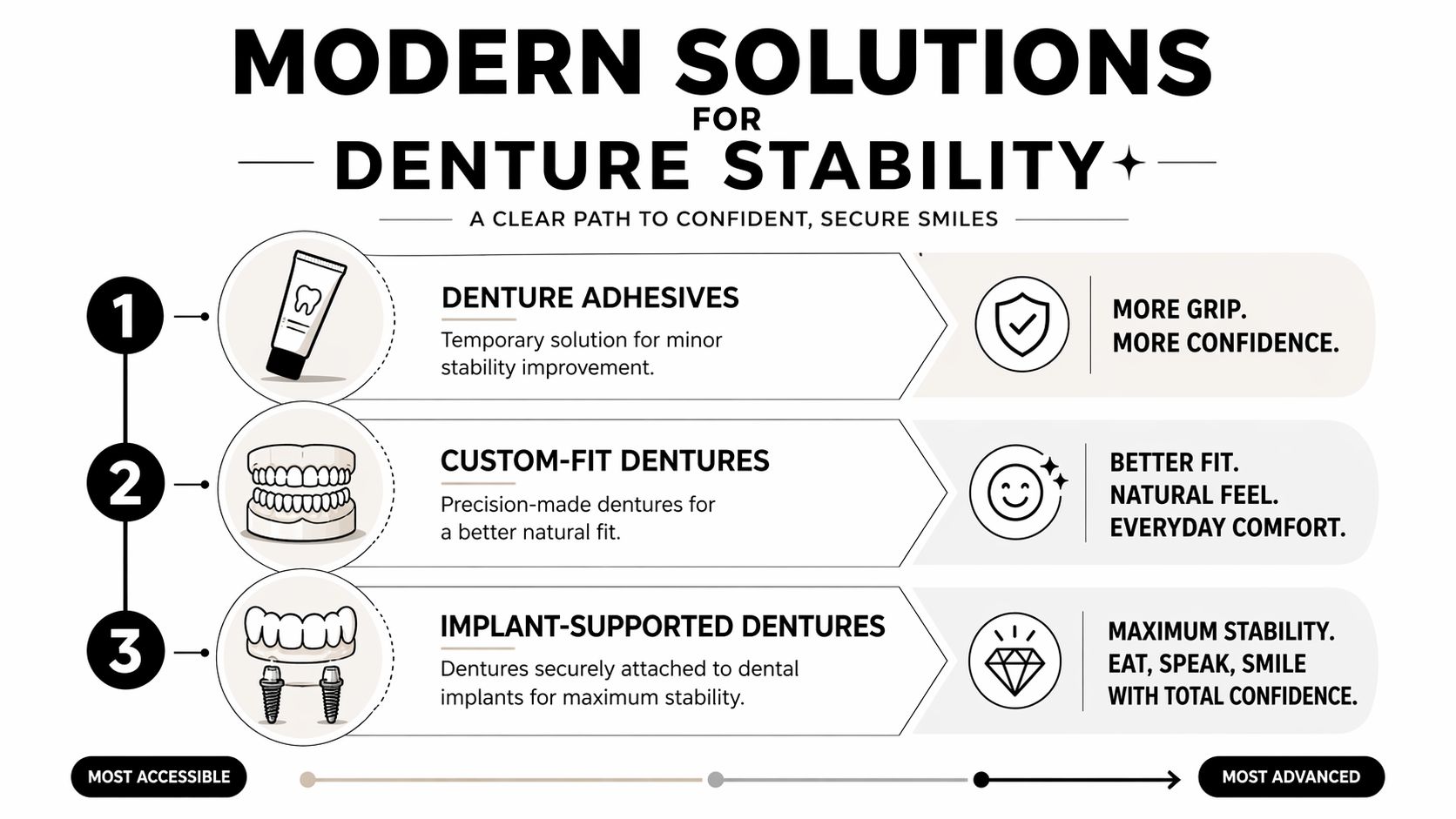
If you’re tired of chasing a better fit, it helps to look at denture stability as a ladder. Some options are temporary aids. Some restore the fit of the denture you already have. Some change the entire level of support.
Denture adhesives
Adhesives can help when a denture has minor looseness or when a patient needs extra confidence for short-term use. They can be useful. They just shouldn’t be expected to solve a major fit problem.
Use them as a support, not a substitute.
- Best role: Temporary help for mild movement
- Not ideal for: Significant looseness, rocking, repeated soreness, or a worn-out denture
- What patients often notice: Some improvement in hold, but cleanup and consistency can be frustrating
Professional relines and fit correction
When the denture base no longer matches the shape of the gums well, a reline may restore contact and improve retention. This is often one of the most practical next steps when the denture itself is still serviceable but the fit has changed.
A reline can be a strong option if:
- The denture teeth and overall structure are still in decent condition
- The main complaint is looseness rather than breakage
- The tissues have changed over time and the base no longer adapts well
For patients comparing options, custom full dentures remain an important part of restorative dentistry. If you’d like to see how a full-arch solution is approached, this page on full upper dentures gives a useful overview.
Implant-supported dentures
For many people, implant-supported dentures offer the most dependable solution. Instead of relying only on the gums and seal, the denture connects to dental implants placed in the jaw. That changes daily function in a major way.
This option is especially attractive to patients searching for dental implants near me because it addresses the complaint they care about most. Movement.
Here’s a side-by-side way to think about the trade-offs:
| Option | Main advantage | Main limitation |
|---|---|---|
| Adhesive | Quick and accessible | Temporary and limited |
| Custom-fit removable denture | Better natural retention | Still dependent on tissue support |
| Implant-supported denture | Maximum stability | Requires implant treatment planning |
The right answer isn’t always the most advanced option first. It’s the option that matches your anatomy, goals, comfort, and long-term plan.
Which option usually makes the most sense
If your denture only slips a little, adhesive may buy time. If the base no longer fits but the prosthesis is otherwise solid, a reline may be the smartest move. If you want the strongest possible stability and you’re a good candidate, implant treatment is often the most impactful path.
Restorative dentistry takes on a personal dimension. Some patients want a practical non-surgical solution. Others are ready for a more secure upgrade that changes how they eat and speak every day. A careful consultation helps sort that out without pressure.
Enjoying Life with a Confident and Secure Smile
The biggest difference a secure denture makes isn’t technical. It’s personal. Patients don’t come in asking for a better peripheral seal. They want to order a meal without worry, talk without adjusting their denture mid-sentence, and laugh without thinking about it first.
Everyday benefits patients notice first
Once the fit is dependable, daily life gets easier in ways that feel immediate.
- Eating becomes less stressful: You can focus on your meal instead of whether the denture will shift.
- Speech feels more natural: Words come out more clearly when the denture stays where it should.
- Social confidence improves: People stop covering their mouth, avoiding restaurants, or hesitating in conversation.

Function and appearance work together
A stable smile supports more than comfort. It supports better choices. When chewing feels easier, patients are often more willing to eat a broader range of foods. When a denture looks natural and feels secure, self-consciousness fades into the background.
That’s where restorative dentistry and cosmetic dentistry often overlap. The goal isn’t only to replace missing teeth. It’s to create a smile that feels healthy, looks natural, and fits the person wearing it.
A secure smile changes small moments first. Then it changes the day around those moments.
For many San Diego patients, that means feeling comfortable at a restaurant, in a family photo, or during a meeting at work. Those outcomes matter just as much as the technical work that made them possible.
Your Denture Consultation at Salami & Associates
If you’ve been living with a loose denture for a while, the first visit should feel clarifying, not intimidating. Patients visiting the Rancho Bernardo office for denture concerns can expect a warm welcome, a conversation about what’s been bothering them, and a thorough look at what’s happening in the mouth.
What your first appointment may include
A consultation often starts with the basics. When did the looseness begin? Is the problem happening while eating, speaking, or both? Are there sore spots? Has the denture been repaired, relined, or adjusted before?
From there, the clinical side becomes more focused:
- A detailed exam
- Evaluation of the current denture fit and bite
- Dental x-rays if they’re needed for diagnosis
- Discussion of options such as adjustment, reline, replacement, or implant-supported treatment
Patients who are anxious usually do best when they know what to expect ahead of time. That same principle helps with scheduling too. If you like practical healthcare communication tips, these proven strategies to reduce patient no show appointments offer a useful reminder that clear preparation lowers stress and helps people follow through on care.
A low-pressure next step
For many new patients from Rancho Bernardo, Rancho Peñasquitos, Poway, and Escondido, the easiest way to begin is with the office’s Exam + X-Ray and Cleaning special. It creates a straightforward entry point for understanding the problem and discussing the best path forward.
You don’t need to guess whether a denture suction cup product will help. You don’t need to keep experimenting on your own. A careful consultation can show you what’s causing the instability and what will give you the most comfortable, lasting result.
If you’re ready for a more secure denture fit and a clearer plan, schedule a consultation with Pegah S. Salami, DMD, FAGD. The team provides compassionate, detail-oriented care for patients in Rancho Bernardo and nearby San Diego communities, with treatment options for comfort, function, and long-term confidence.





