
A missing tooth changes little moments first. You may notice it when someone takes a photo at dinner in Rancho Bernardo, when you laugh with coworkers over lunch in San Diego, or when you start chewing more carefully on one side without even thinking about it.
For some people, the biggest issue is appearance. For others, it is the way speech feels, or the worry that the space will make nearby teeth shift over time. In the consultation room, I often meet patients from Poway, Escondido, and Rancho Peñasquitos who tell me the same thing in different words. “I want something that looks natural, but I do not want more dental work than I need.”
That is where a Maryland bridge can be worth discussing. It is not the right answer for every missing tooth, and I believe patients deserve a clear explanation of when it fits and when another option makes more sense. If you are comparing solutions, this guide to missing tooth treatment options can also help you see the bigger picture.
At our Rancho Bernardo practice, we look at the whole situation before recommending anything. Your bite, the location of the missing tooth, the condition of the neighboring teeth, your timeline, and your comfort level all matter. Sometimes a Maryland bridge is a smart, conservative choice. Sometimes a traditional bridge or a dental implant is the better long-term plan.
Missing a Tooth in San Diego Your Guide to a Confident Smile
A missing tooth can make a very social city feel surprisingly stressful. You may hesitate during a family gathering, angle your face away in photos, or avoid certain foods when you are out with friends.
I have seen this with adults who lost a front tooth years ago and finally feel ready to replace it. I have also seen it with younger patients who are not ready for a dental implant yet but want a fixed tooth replacement that feels more natural than a removable option.
Why patients often delay treatment
Many people are not avoiding care because they do not care about their smile. They are avoiding care because they are unsure what the treatment will involve.
Some common worries sound like this:
- “Will you have to drill the teeth next to it?” Patients often fear that replacing one tooth means sacrificing two healthy ones.
- “Will it look obvious?” This question comes up most often when the missing tooth is in the front.
- “Is this something temporary or something I can trust?” The answer depends on the case, which is why a careful exam matters.
A Maryland bridge can answer some of those concerns because it is designed to be more conservative than a conventional bridge. It gives us a way to replace a single missing tooth while preserving much more of the natural tooth structure on the teeth beside the space.
A practical option for the right person
In real life, this treatment often appeals to people who want a solution that is fixed, natural-looking, and less invasive. That can include a teen waiting until the timing is right for an implant later, or an adult who wants to restore a front tooth without moving straight to a surgical procedure.
A good tooth replacement plan should match your goals, not just fill a space.
If you have been searching for a dentist in San Diego, CA, a cosmetic dentist near me, or restorative care that feels straightforward and personal, a Maryland bridge may be one of the options worth reviewing during your visit.
What Exactly Is a Maryland Dental Bridge
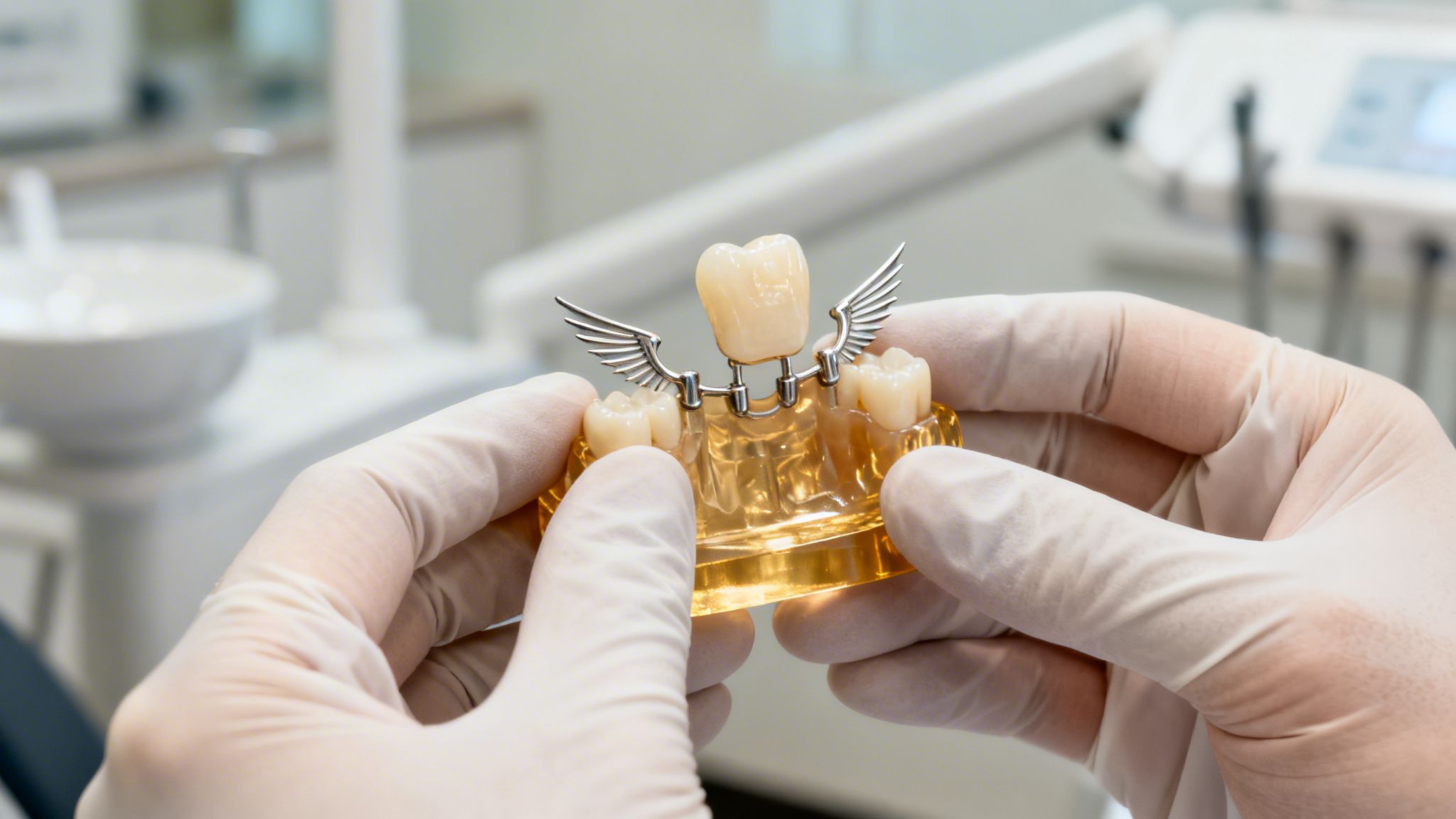
A Maryland dental bridge is a fixed tooth replacement used most often for one missing front tooth. It includes an artificial tooth, called a pontic, and small supporting extensions called wings that attach to the back surfaces of the neighboring teeth.
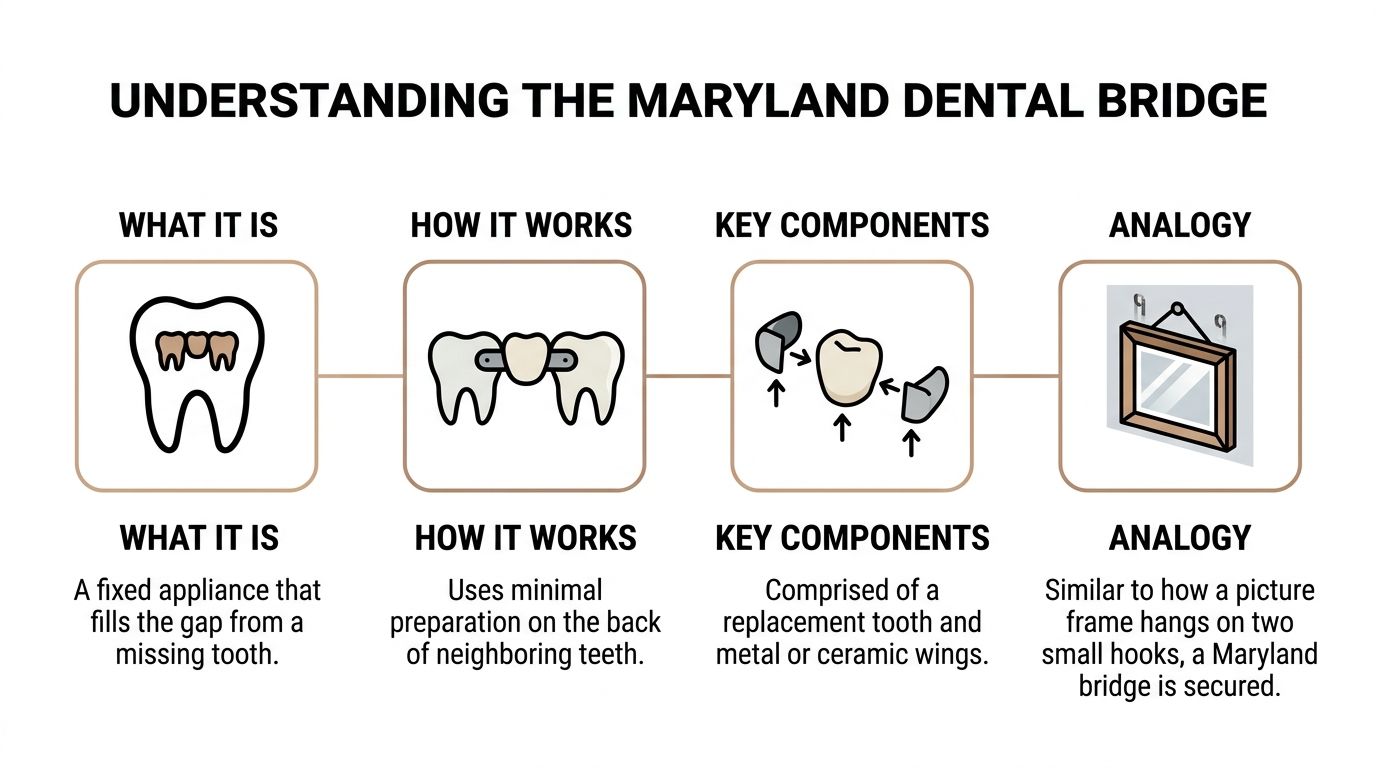
Many patients ask me, in plain terms, “So what is a maryland bridge dental treatment supposed to do?” The easiest answer is this. It fills the gap with a replacement tooth while avoiding the full crowns a traditional bridge usually needs.
Picture frame analogy
A simple analogy helps. Think of the replacement tooth like a framed picture that needs support. A traditional bridge is more like cutting into the wall and adding larger hardware. A Maryland bridge is closer to using small, secure hooks on the back side so the wall stays mostly intact.
That is why it is called a conservative option. It is designed to hold the new tooth in place while preserving healthy enamel on the adjacent teeth.
What the bridge is made of
The bridge has two main parts:
- The pontic. This is the replacement tooth that sits in the space.
- The wings. These are thin metal or ceramic extensions that bond to the back of the neighboring teeth.
According to Aspen Creek Dental’s explanation of Maryland bridge design, a Maryland bridge uses a pontic with thin metal or ceramic wings bonded to the back of adjacent teeth, and this approach preserves over 90% of the natural tooth structure compared with a traditional bridge. That same source notes that the wings are treated to create a micro-retentive surface, allowing resin cements to reach shear bond strengths of 20 to 40 MPa under ideal conditions.
Why patients like this design
If the teeth next to the gap are healthy, many people like the idea of not covering them with crowns just to replace one missing tooth. That is the main appeal.
Here is what often makes this treatment attractive:
- Less drilling on healthy teeth
- A fixed replacement instead of a removable one
- Aesthetic results for front teeth
- A simpler treatment path than some alternatives
The key idea is preservation. We want to replace the missing tooth while disturbing as little healthy tooth structure as possible.
Why it is different from a traditional bridge
A traditional bridge generally depends on full crowns placed over the teeth on either side of the space. That can be a good option in some cases, especially when those teeth already need crowns.
A Maryland bridge works differently. It relies on bonded support from the back surfaces of nearby teeth. That makes it less invasive, but it also means case selection matters more. This type of bridge is not meant for every location in the mouth.
Who Is an Ideal Candidate for a Maryland Bridge
A Maryland bridge shines in a fairly specific situation. It is usually most successful when there is one missing front tooth, the neighboring teeth are healthy, and the bite does not place too much stress on the bonded wings.

When this option tends to work well
Research summarized in the PubMed Central review on resin-bonded bridges notes that careful case selection is essential, and excellent results are seen in patients with small gaps between sound teeth. That review also reports an average lifespan of 7 to 10 years and five-year survival rates of 85 to 90%, especially when used as an interim solution for single anterior teeth in adolescents and young adults.
That tells us a lot in practical terms.
A Maryland bridge may be a good fit if:
- You are missing one front tooth. Front teeth usually place less chewing force on the bridge than back teeth.
- The teeth next to the space are in good condition. Strong enamel gives the bond a better foundation.
- You want to preserve healthy tooth structure. This is often the reason patients ask about this option.
- You are younger and not ready for an implant yet. This can be helpful in selected teen and young adult cases.
When I become more cautious
I tend to be more careful about recommending a Maryland bridge when the situation includes heavy bite forces, clenching, grinding, or neighboring teeth with significant prior dental work. Those conditions can make long-term bonding less predictable.
This option is also generally not my first choice for molars. Back teeth absorb much stronger chewing pressure, and that can challenge the bond.
Here are some signs another option may fit better:
- You grind or clench your teeth
- The missing tooth is in the back of the mouth
- The adjacent teeth have large fillings or structural damage
- Your bite places unusual force on that area
A Maryland bridge is not “better” than every other option. It is better for the right case.
The candidacy check we do in office
During an exam, I look closely at the space itself and at the teeth around it. I want to know whether the neighboring teeth are strong enough to support the bridge and whether your bite allows the restoration to sit in a protected position.
Patients often come in asking for one treatment by name. What they really need is a recommendation that matches their mouth. Sometimes the answer is a Maryland bridge. Sometimes it is a traditional bridge. Sometimes the most durable path is an implant.
The Maryland Bridge Procedure at Our Rancho Bernardo Office
For many patients, the hardest part is not the treatment itself. It is the uncertainty before the first visit. Once you understand the steps, the process usually feels much more manageable.
First visit and planning
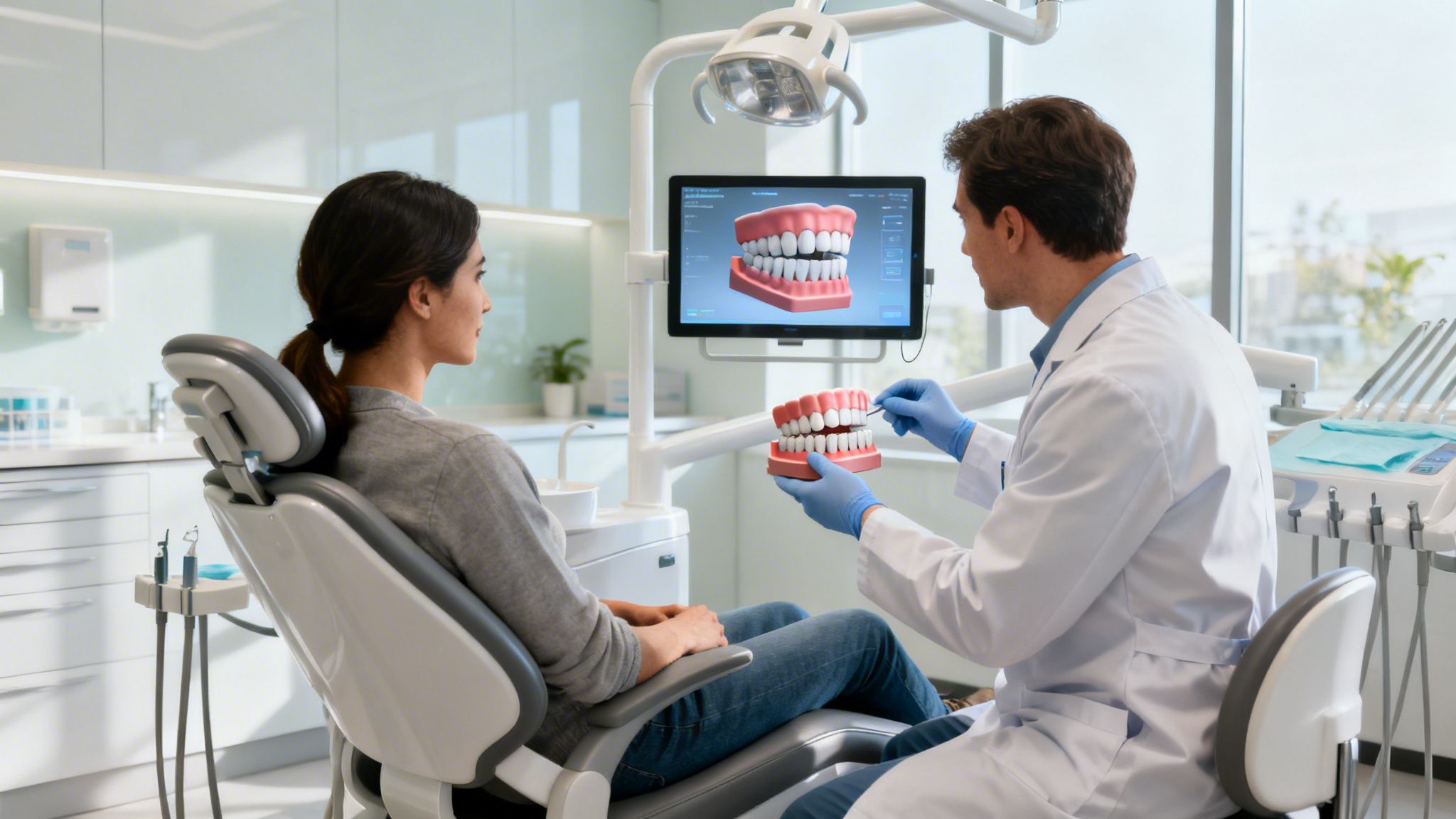
Your appointment starts with a conversation. We talk about what happened, what is bothering you most, and what you want your smile to feel like when treatment is done.
Then I examine the area, evaluate the neighboring teeth, and review any needed digital imaging. Here, we decide whether a Maryland bridge is the right fit or whether another restorative option would serve you better.
If you want a more detailed overview of timing and treatment flow, this guide on the dental bridge procedure step by step can help.
Minimal preparation
One of the biggest advantages of this treatment is that preparation is limited. Instead of reducing the supporting teeth for full crowns, we usually make only minimal changes, mainly on the back surfaces where the bridge will bond.
Patients often find this reassuring because the healthy visible portions of the neighboring teeth remain largely untouched.
Digital design and materials
Material choice matters, especially in the front of the mouth where appearance is important. According to Burbank Dental’s discussion of metal-free Maryland bridges and digital workflow, metal-free Maryland bridges made from materials such as zirconia can be used for improved aesthetics, and these restorations require specific primers and bonding agents to achieve strong adhesion of 25 to 35 MPa. That same source notes that practices using CEREC technology can use digital scanning for precise in-office milling, which may reduce appointments and lab costs.
At Pegah S. Salami, DMD, FAGD, digital scanning and restorative planning are part of how we evaluate fit, symmetry, and shade when a bridge is being considered.
A short video can make the idea feel more real before you come in.
Bonding day
When the bridge is ready, we try it in, check the fit, confirm the appearance, and then bond it into place. The appointment is typically straightforward.
You can expect me to pay attention to small details:
- Bite balance. The bridge should not take more force than it should.
- Color match. The goal is for the pontic to blend naturally with your smile.
- Comfort. We make sure it feels smooth and natural against your tongue.
Most patients are pleasantly surprised by how conservative this process feels compared with what they expected.
What the appointment feels like
Patients who come in searching for a dentist near me or a best dentist in Rancho Bernardo, CA are often looking for more than technical skill. They want calm communication and a clear plan.
That is especially true if you have dental anxiety. In our office, we explain each step before we do it. There is no benefit in making treatment feel mysterious.
Key Benefits and Limitations of Choosing a Maryland Bridge
A Maryland bridge is appealing for a reason. It can solve a visible problem in a conservative way. But it also has limitations, and I think patients make better decisions when they understand both sides clearly.
The main benefits
The strongest argument for a Maryland bridge is tooth preservation. If the neighboring teeth are healthy, keeping them largely intact is a major advantage.
Patients also tend to appreciate these practical benefits:
- Conservative treatment. Less tooth reduction than a conventional bridge.
- Good appearance for front teeth. This matters when the missing tooth shows in your smile.
- A fixed option. Many people prefer this over something removable.
- A shorter and simpler path than an implant in selected cases.
The limitations patients should know
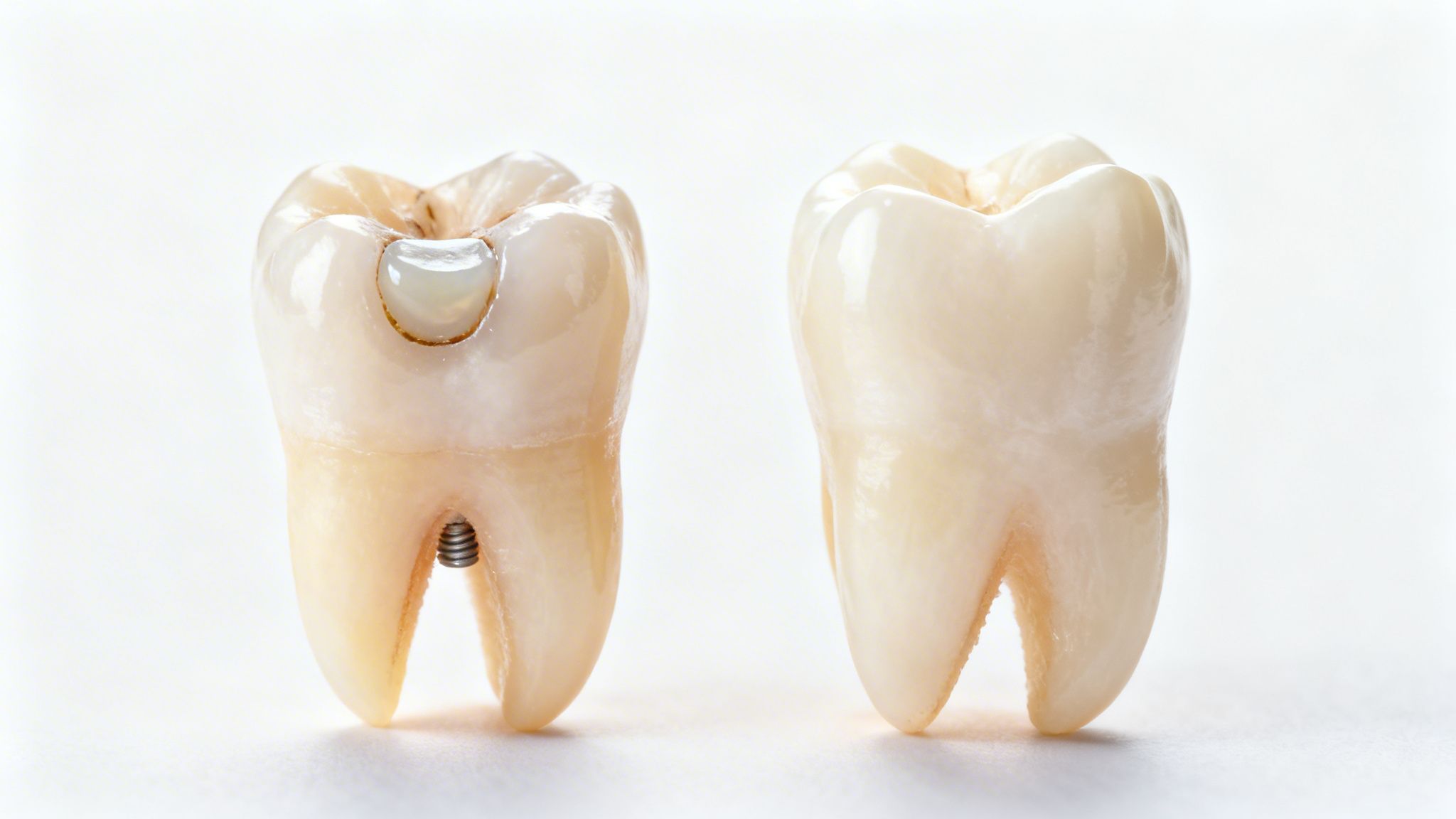
The main drawback is bonding risk. Because the bridge depends on bonded wings rather than full crowns or a surgically placed implant, it can come loose.
According to SCDL’s review of Maryland bridge outcomes, Maryland bridges can achieve a 77% survival rate after 10 years, and that outcome improves when rebonding is performed after dislodgement. The same source reports that the most common complications are debonding in 21% of cases and tooth discoloration in 18% of cases, with typical longevity of 7 to 10 years depending on bonding quality, bite forces, and hygiene.
That is useful information because it sets realistic expectations.
A balanced way to think about it
Here is a simple comparison of how many patients think through the decision:
| Consideration | Maryland bridge |
|---|---|
| Tooth preservation | Strong advantage |
| Front tooth aesthetics | Often very good |
| Strength under heavy chewing | More limited |
| Long-term predictability | Depends heavily on case selection and maintenance |
| Repair after loosening | Often possible with rebonding |
If your top priority is preserving the adjacent teeth, a Maryland bridge deserves consideration. If your top priority is maximum durability under heavy function, another option may fit better.
Why honesty matters here
A lot of treatment dissatisfaction happens when expectations are vague. This restoration can work very well in the right place, especially for a single front tooth. It is not the same as saying it is the right replacement for every missing tooth.
That distinction matters whether you are seeking restorative dentistry, cosmetic dentistry, or trying to decide between a bridge and dental implants near me.
Aftercare Longevity and Protecting Your Investment
Once a Maryland bridge is in place, daily care matters. A well-made restoration still depends on healthy supporting teeth and clean gum tissue around it.
Patients often ask a very practical question. “How do I clean under this?” That is the right question to ask.
Daily habits that help
The area under the pontic needs attention because plaque can collect there. The bridge also creates small contours around the bonded wings that need to be kept clean.
Helpful tools often include:
- Floss threaders for guiding floss beneath the bridge
- Water flossers for rinsing around hard-to-reach areas
- Soft toothbrushes to clean the gumline gently
- Non-abrasive toothpaste to avoid unnecessary wear
If a patient has a history of clenching or grinding, I may also discuss protection at night. Extra force is not a friend to bonded restorations.
Foods and habits to watch
Many individuals can function normally with a Maryland bridge, but it is smart to be thoughtful about how you use it. Biting directly into very hard foods with the bridge area can place unnecessary stress on the bond.
A few sensible precautions include:
- Avoid using the bridge like a tool to tear open packaging
- Be careful with very hard foods at the front teeth
- Do not ignore changes such as looseness or an unusual bite feel
If the bridge ever feels slightly mobile, call early. Small issues are easier to manage than delayed ones.
Professional maintenance matters
The St. Anthony Park Dental Care article on Maryland bridge maintenance notes that long-term success requires excellent oral hygiene, that failures can increase with plaque accumulation or teeth grinding, and that specialized tools are important for cleaning under the wings to help prevent gingivitis. It also highlights the value of regular professional cleanings, including laser-assisted cleanings where appropriate.
That aligns with what we see in practice. Home care and routine visits work together. During cleanings and exams, we monitor the supporting teeth, check the bridge margins, and make sure everything remains stable.
Signs to call us sooner
You do not need to wait for pain to reach out. Contact the office if you notice:
- A change in how the bridge fits
- Food trapping that seems new
- A rough edge or movement
- Gum irritation around the area
When patients stay on top of maintenance, they usually feel more confident and get more life from their restoration.
Comparing Your Options Traditional Bridge vs Dental Implant
If you are missing a tooth, a Maryland bridge is only one of the possible solutions. In many consultations, the primary decision is not “bridge or no bridge.” It is which type of bridge, or whether an implant is the better path.
Maryland bridge versus traditional bridge
A traditional bridge typically uses crowns on the teeth next to the gap. That can provide stronger mechanical support, which is why conventional bridges are often considered for areas with more chewing force.
The tradeoff is tooth reduction. If those neighboring teeth are healthy and untouched, preparing them for crowns may feel like more treatment than you want.
A Maryland bridge preserves much more of those teeth. That makes it attractive when the space is in the front and the supporting teeth are in good condition. Its limitation is that it relies on bonding, so it is usually less ideal in high-force situations.
Maryland bridge versus dental implant
A dental implant is different because it replaces the missing tooth without attaching to neighboring teeth. It is a standalone option and often the solution people choose when they want the most independent replacement possible.
That independence is a major advantage. The tradeoff is that implants involve surgery, healing, and a different timeline.
Here is a simple way many patients sort through the options:
- Choose a Maryland bridge when preserving nearby teeth is a high priority and the case is favorable.
- Consider a traditional bridge when the adjacent teeth already need crowns or the area needs more strength.
- Think about an implant when you want a standalone replacement and are comfortable with a surgical approach.
The right answer depends on your priorities
There is no single “best” choice for everyone in Rancho Bernardo, Poway, or Escondido. A patient who wants the most conservative front tooth replacement may lean toward a Maryland bridge. Another patient may prefer the long-term independence of an implant. A third may already have damaged neighboring teeth, making a traditional bridge more sensible.
My role is to help you weigh function, aesthetics, comfort, timeline, and long-term maintenance in a way that fits your goals.
Frequently Asked Questions About Maryland Bridges
Can a Maryland bridge replace a molar
Usually, this is not the first choice for a molar. Back teeth handle much more chewing pressure, and that makes a bonded design less favorable there. For many molar cases, a traditional bridge or implant is more appropriate.
Does getting a Maryland bridge hurt
Most patients find the process easier than they expected. Because preparation is minimal, treatment is often less invasive than a conventional bridge. If any area is sensitive, we address comfort carefully during the appointment.
Will people be able to tell I have one
In a well-planned case, the bridge is meant to blend into your smile. This is one reason Maryland bridges are often used for front teeth. Shade, shape, and bite all matter to the final result.
Is it bad for the teeth next to the gap
This option is specifically valued because it preserves the neighboring teeth much more than a traditional bridge. That said, the supporting teeth still need to be healthy and well maintained. The bridge depends on them.
What if it comes loose
If a Maryland bridge loosens, do not try to force it back into place yourself. Call the office. In some situations, rebonding may be possible, depending on the condition of the bridge and the supporting teeth.
Is a Maryland bridge permanent or temporary
It can serve as a lasting restoration in the right case, but many dentists also use it as an interim solution, especially for younger patients who may consider an implant later. The answer depends on your age, bite, oral habits, and long-term plan.
How do I know if I am a candidate
The only reliable way to know is to have the area examined. The missing tooth location, the health of the adjacent teeth, and your bite pattern all influence whether this is a strong option for you.
If you are in Rancho Bernardo, Rancho Peñasquitos, Poway, or Escondido and want clear answers about replacing a missing tooth, scheduling a consultation can give you a personalized plan instead of a guess.
If you are considering a Maryland bridge, a traditional bridge, or dental implants, Pegah S. Salami, DMD, FAGD offers consultations in the Rancho Bernardo area to help you compare your options with a clear, patient-focused approach. We can evaluate the missing tooth, review your goals, and recommend the treatment that best fits your smile, comfort, and long-term oral health.





