
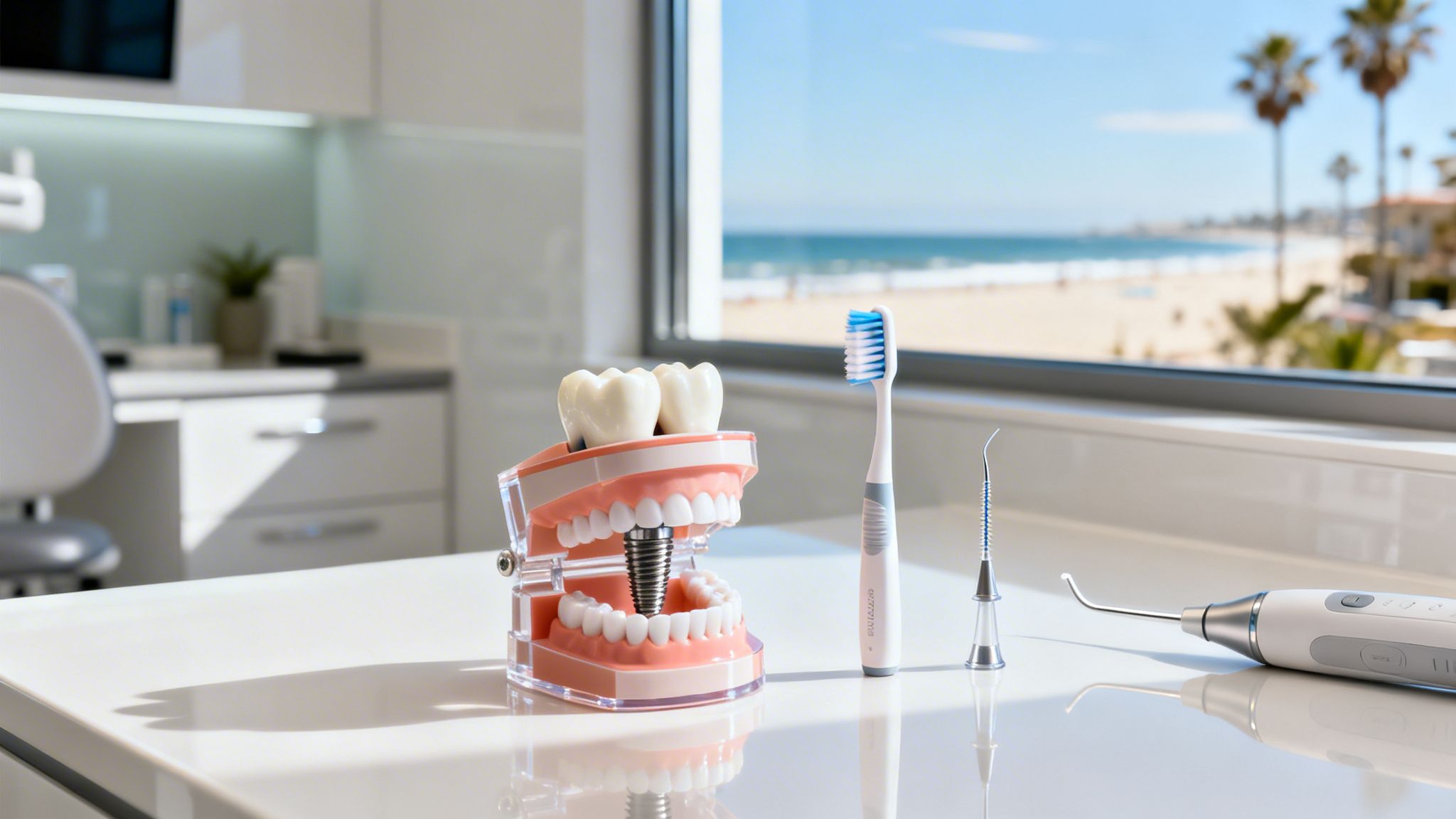
Getting a dental implant is an exciting step toward restoring your smile and confidence. If you've been searching for a "cosmetic dentist near me" because of a missing tooth, you know the impact it can have on your daily life. Here in our Rancho Bernardo, CA, practice, we help patients from all over the San Diego area regain not just the look of their smile, but its full function and feel. We want to ensure that renewed confidence lasts a lifetime.
The great news is that proper implant care is surprisingly simple. It blends right into your daily routine and is a partnership between you and our dental team. At Pegah S. Salami, DMD, FAGD, we are committed to being your trusted local dentist, guiding you through gentle at-home hygiene, smart lifestyle choices, and regular professional check-ups to protect your new smile.
Your Guide to Lifelong Dental Implant Success
Dental implants are built to last, but their real staying power comes from how you care for them after your procedure. As a local dentist serving our neighbors in Rancho Bernardo and nearby Poway, we feel it's our job to provide the practical, real-world advice you need to protect your investment.
The best way to think about your implant is to treat it like a natural tooth—perhaps even a little better. You must be just as diligent to prevent issues like plaque buildup and gum inflammation. If bacteria gather at the base of an implant, it can cause a condition called peri-implantitis. This infection is the biggest threat to an implant’s stability, but it's also highly preventable with the right dental care.
The Pillars of Implant Care
Your long-term success is built on a simple and consistent routine. It’s a manageable commitment that pays off for decades.
- Excellent At-Home Hygiene: This means more than a quick brush. We'll show you the right tools and techniques to clean around the implant without causing irritation.
- Healthy Lifestyle Habits: What you eat and your daily routines play a huge role in keeping the bone and gum tissue around your implant strong and healthy.
- Regular Professional Maintenance: Visiting our San Diego office for routine cleaning and exams allows us to perform specialized cleanings and monitor your implant's health with professional tools you don't have at home.
This timeline gives you a great visual of how these three elements work together to ensure your implant thrives for years to come.
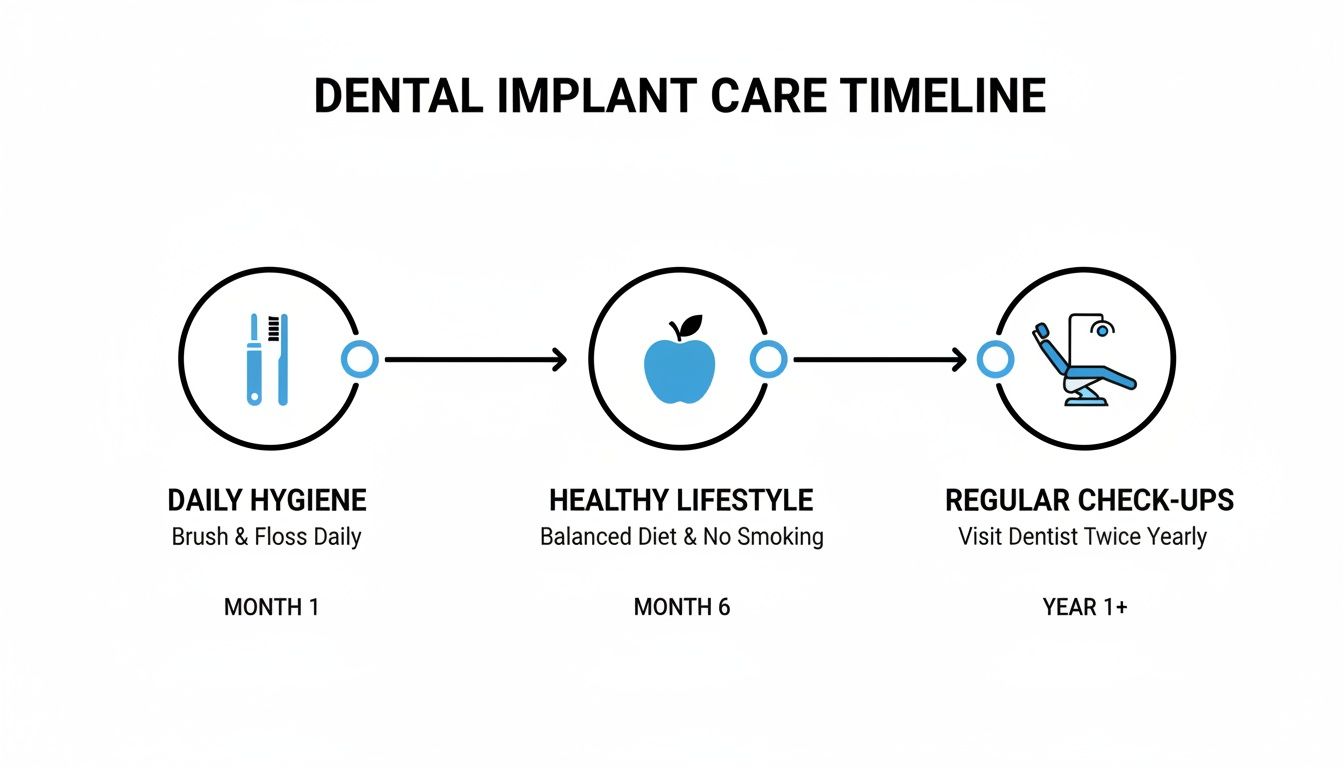
As you can see, the daily actions you take at home, combined with our professional oversight, create a powerful defense for your smile. By embracing this straightforward, three-part strategy, you’ll be set to enjoy the benefits of your dental implant for decades. And as your local dentist in San Diego, we’ll be here to support you every step of the way.
Navigating the First 48 Hours After Your Implant Procedure
The first two days after your dental implant surgery are the most critical part of your recovery. What you do at home during this time sets the stage for how quickly you heal and how comfortable you feel. Whether you needed a tooth extraction before your implant or are simply replacing a long-lost tooth, this initial phase is key.
Think of this period as laying the groundwork for your implant's success. Our San Diego team is always here for you, but knowing how to care for yourself after leaving our office is essential for a smooth journey.

It's completely normal to see mild swelling, feel some tenderness, and notice minor bleeding around the implant site. This is your body's natural healing process, and our goal is to help you manage it with confidence. If at any point your symptoms feel severe, please contact our office for emergency dentist services.
Managing Swelling and Discomfort
Getting ahead of inflammation is your top priority in the first 48 hours. Swelling often peaks around the second or third day before it starts to improve.
You can make a huge difference by applying a cold compress or ice pack to the outside of your cheek. Follow a simple cycle: 15 minutes on, then 15 minutes off. This helps constrict blood vessels and prevents fluid buildup.
For any soreness, take the pain medication we discussed during your appointment. If you stick to the recommended schedule, especially on the first day, you can stay ahead of the pain instead of trying to play catch-up later.
A Note on Rest: Your body needs all its energy to heal. For at least two days, avoid strenuous workouts, heavy lifting, or even bending over. Keeping your blood pressure steady is one of the best ways to prevent extra bleeding or swelling at the implant site.
Your Post-Op Diet and Oral Hygiene
Protecting the surgical area is absolutely crucial. For the first few days, this means sticking to a diet of soft foods. Enjoy smoothies, lukewarm soups, yogurt, and mashed potatoes.
To keep the healing tissue safe, avoid a few things:
- Hot Foods and Drinks: These can increase blood flow and risk dislodging the important blood clot.
- Crunchy or Hard Foods: Chips, nuts, and hard bread can irritate the site and cause unnecessary pain.
- Using Straws: The sucking motion can dislodge the blood clot, leading to a painful complication called dry socket.
Keeping your mouth clean is just as vital, but you must be incredibly gentle. Do not brush the implant site directly for the first few days.
About 24 hours after your surgery, start gentle saltwater rinses. Mix half a teaspoon of salt into a cup of warm water and let the water flow over the surgical area. No vigorous swishing—a simple head tilt is all you need. Do this 2-3 times a day, especially after eating, to keep everything clean and promote healing.
Following these tips will go a long way in preventing complications and getting you on the fast track to a comfortable recovery. If you notice worsening pain or have other concerns, don't hesitate to call our Rancho Bernardo office right away.
Crafting Your Daily Implant Care Routine
Once you're through the initial healing, your daily cleaning habits become the most important factor in your dental implant's long-term success. I often tell my patients to think of their implant like a classic car; it's a high-performance machine that needs consistent, specialized care to run perfectly for decades. This is where you take control to protect your investment.
As your dedicated dentist in Rancho Bernardo, my goal is to give you the confidence and techniques to care for your new smile. A solid daily routine is your best defense against plaque and bacteria—the main threats to a healthy implant.
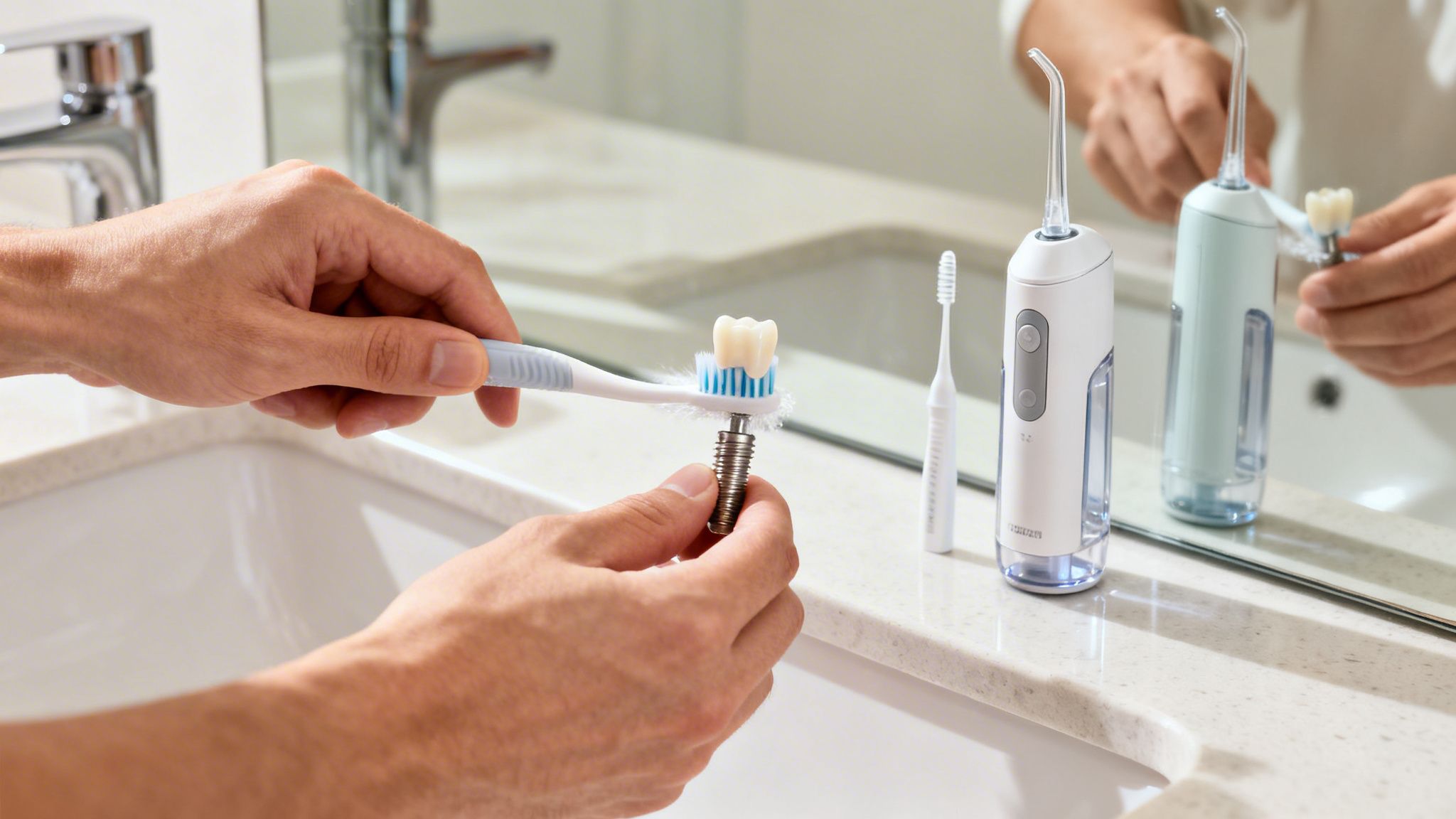
Ultimately, the goal is to prevent a condition called peri-implantitis. It’s an infection, much like gum disease, that can damage the bone holding your implant in place. The good news? With the right approach, it's almost entirely preventable.
Mastering the Brushing Basics
Here’s something most people don’t know: natural teeth have a tiny ligament that acts as a physical barrier against bacteria. Implants don't. This makes your gum line the first and only line of defense.
Always start with a soft-bristled toothbrush. Stiff bristles can scratch your new crown and irritate your gums. You'll also want to use a low-abrasive, non-whitening toothpaste. Many whitening formulas have abrasive particles that create micro-scratches on the crown’s surface, giving plaque more places to hide.
When you brush, angle the bristles at 45 degrees toward the gum line and use gentle, circular motions. Focus on cleaning every surface of the crown, giving extra attention to that critical spot where the crown meets your gums.
Going Beyond Brushing and Flossing
While brushing is non-negotiable, it simply can’t clean the most important areas—the small spaces between your implant and neighboring teeth, or underneath the implant crown. This is where a few specialized tools become your best friends. Many of our patients across the greater San Diego area tell us these make all the difference.
- Water Flossers: Sometimes called oral irrigators, these devices are fantastic. They use a pulsed stream of water to gently flush out plaque and food particles from around the implant. They are incredibly effective and much gentler on the gums than traditional string floss.
- Interdental Brushes: Think of these as tiny pipe cleaners for your teeth. These small, cone-shaped brushes are perfect for cleaning the sides of the implant post and the abutment. Just be sure to get a version with nylon-coated wire to avoid scratching any implant components.
- Implant-Specific Floss: This isn't your average floss. It’s designed with a stiff end for easy threading under the crown and a spongy, thicker section that gently wipes the implant post clean.
The long-term success of your implant truly hinges on this daily care. The data backs this up—studies show that diligent, proper hygiene can push long-term success rates to an impressive 95% over 10 years. On the flip side, that rate can drop significantly when care is inconsistent. Plaque buildup can lead to peri-implantitis, a serious condition that may affect up to 20% of implants if they are neglected. You can explore the data behind implant success for a deeper look.
To make it simple, we've put together a list of the essential tools we recommend to all our implant patients. Think of this as your starting toolkit for excellent implant health.
Your Recommended Daily Implant Care Toolkit
| Tool/Product | Why It's Recommended | How to Use |
|---|---|---|
| Soft-Bristled Brush | Prevents scratching the implant crown and irritating sensitive gum tissue. | Use gentle, circular motions, angling the brush at 45 degrees toward the gum line. |
| Water Flosser | Effectively flushes out plaque and debris from hard-to-reach areas around the implant. | Aim the stream at the gum line and between teeth, starting on a low-pressure setting. |
| Interdental Brush | Cleans the sides of the implant and abutment where a toothbrush can't reach. | Gently insert the brush between the implant and adjacent teeth, moving it back and forth. |
| Implant Floss | Designed with a stiff end to thread under the crown and a spongy part to clean. | Thread the stiff end under the implant bridge or crown and wrap the floss around the post. |
Adopting this new routine might feel a little strange at first, but I promise it will quickly become second nature. Committing just a few extra minutes each day is the single best thing you can do to ensure your beautiful new smile lasts a lifetime.
Lifestyle Choices That Protect Your Dental Implant
While your daily cleaning routine is the cornerstone of implant care, your lifestyle choices play a massive role in whether your new smile lasts a lifetime. Think of it this way: hygiene protects your implant from the outside, while your daily habits support it from the inside out.
Making a few smart adjustments isn’t just about the initial healing—it’s about ensuring your implant remains strong and stable for decades. Here in our Rancho Bernardo practice, we’ve seen firsthand how deeply connected oral health and overall wellness are. The simple choices you make every day can either bolster or undermine your investment in a beautiful, functional smile.
The Dangers of Smoking and Vaping
If there’s one habit I urge every implant patient to stop immediately, it's smoking. The nicotine and chemicals in cigarettes and vapes are disastrous for healing because they constrict your blood vessels. This dramatically reduces the flow of oxygen and nutrients to your jawbone and gums.
This poor circulation chokes the healing process and directly interferes with osseointegration—that critical fusion between your jawbone and the implant. Without it, the implant simply won't be stable. It’s no surprise, then, that smokers face a much higher risk of implant failure.
The data is incredibly clear. Studies show smokers have a staggering 140.2% higher risk of implant failure. In stark contrast, non-smokers with well-managed health see a 92.5% implant survival rate over five years. These numbers aren't just statistics; they represent real-world outcomes we see all the time. You can learn more about dental implant success factors to see the full picture of what contributes to a successful outcome.
Fueling Your Body for a Healthy Smile
Just as the right fuel keeps a car running smoothly, the right nutrients help your body build strong bone and healthy gum tissue around your implant. A balanced diet isn't just good for your general health; it's absolutely essential for your oral health, too.
We always recommend focusing on a diet rich in a few key vitamins and minerals:
- Vitamin C: This is a powerhouse for producing collagen, the protein that forms the foundation of healthy gums. You'll find it in citrus fruits, bell peppers, and broccoli.
- Vitamin D: Often called the "sunshine vitamin," this is what helps your body absorb calcium. Without it, the calcium you consume can't do its job of building and maintaining strong bone density around your implant.
- Calcium: The primary mineral that gives your jawbone its strength. You can get it from dairy products, leafy greens, and fortified foods.
Protecting Your Smile in San Diego: For our active patients in San Diego who love sports, protecting your new implant is just as important as protecting your natural teeth. A professionally made, custom-fit mouthguard is an essential piece of gear. It absorbs impact and helps prevent a stray ball or accidental collision from causing serious damage to your smile.
Habits to Avoid for Long-Term Success
Beyond diet, a few other common habits can put your implant at risk. Your new implant is incredibly strong, but it isn't indestructible.
To prevent fractures or damage to the beautiful porcelain crown, you have to avoid chewing on extremely hard things. This includes ice cubes, hard candies, and un-popped popcorn kernels. And please, never use your teeth—implant or natural—as tools to open packages or bottles.
These mindful choices, combined with a solid hygiene routine and professional check-ups, create the ultimate strategy for caring for your dental implants. By aligning your lifestyle with your oral health goals, you’re taking the most important steps to protect your smile for a lifetime.
Your Dentist: Your Partner in Long-Term Implant Success
While your daily care routine is the foundation for healthy implants, it's only half the story. The other crucial half? Partnering with your dental team for regular professional maintenance. This is what truly secures the longevity of your investment and makes us the best dentist in Rancho Bernardo, CA, for your continuing care.
Here at our office, these visits are far more than just a standard cleaning. Think of them as a proactive strategy to protect your new smile for a lifetime.
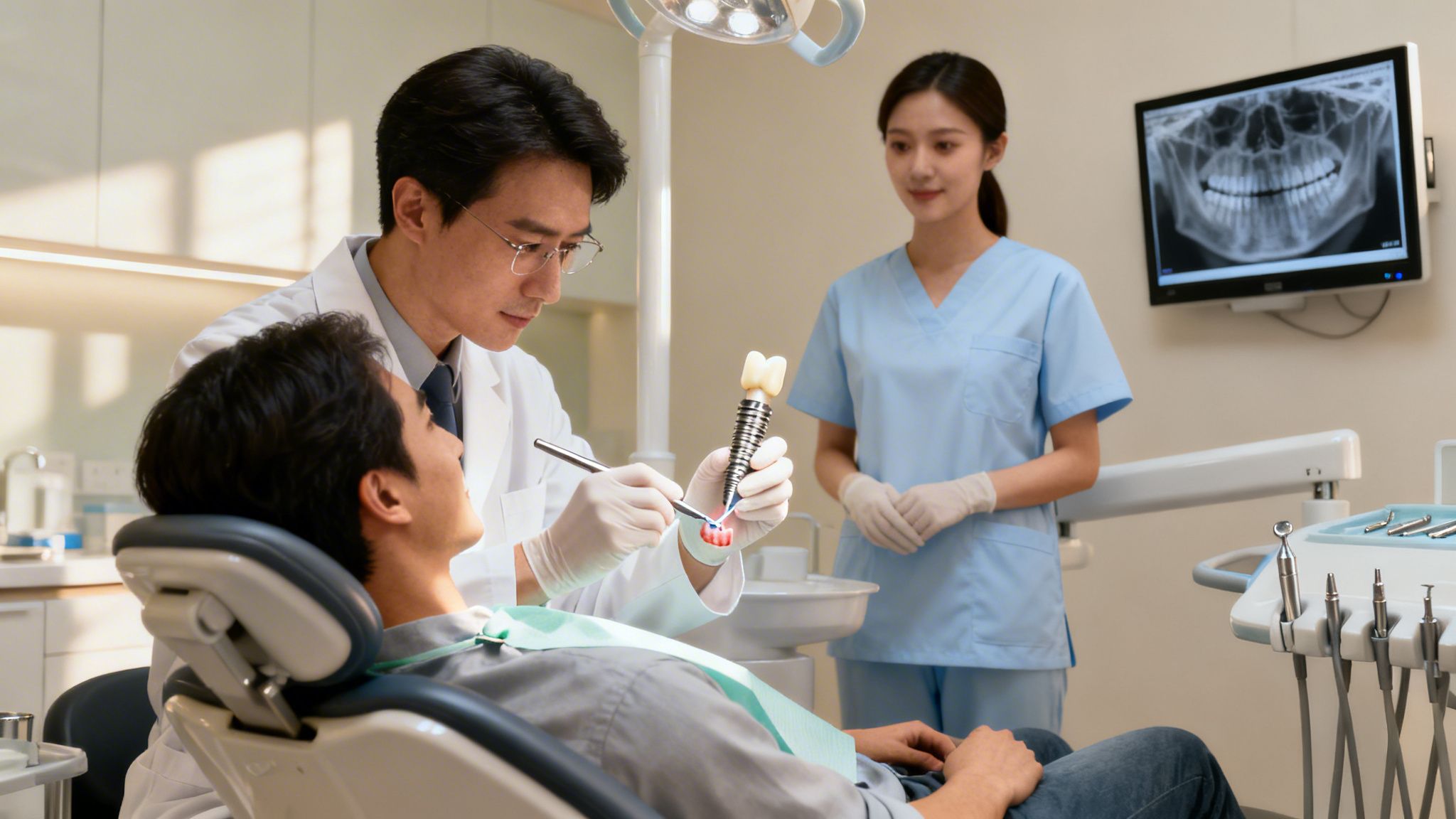
Think of us as your co-pilots on this journey. We have specialized tools and diagnostic technology like dental x-rays to spot things you can’t see at home, allowing us to address tiny issues before they become bigger problems. This ongoing partnership is how we help patients from Escondido to Poway enjoy decades of confident, trouble-free smiles.
What to Expect During a Professional Implant Cleaning
A professional cleaning for an implant isn't the same as one for natural teeth. The materials—the titanium post and the beautiful porcelain crown—need a special touch. The goal is to avoid creating microscopic scratches where plaque can hide and multiply.
Our hygienists use specialized instruments made from materials like resin or titanium. These tools are tough enough to remove stubborn, hardened plaque (tartar) but gentle enough to leave the implant’s surface perfectly smooth and polished. It’s a critical step in preventing the kind of bacterial buildup that leads to gum inflammation and peri-implantitis. You can learn more about the differences in our guide comparing a standard teeth cleaning vs a deep cleaning.
Why Routine X-Rays Are So Important
What’s happening below the gumline is just as important as what’s visible above it. That’s why periodic dental X-rays are a non-negotiable part of your implant care plan. These images give us an inside look at the health of your jawbone and the implant itself.
With X-rays, we can:
- Monitor Bone Levels: We check to ensure the bone is still tightly fused with the implant post, which is key to its stability.
- Spot Hidden Problems: We can catch early signs of infection or inflammation that aren't causing any pain or visible symptoms yet.
- Confirm a Perfect Fit: We verify that the abutment and crown are still seated correctly, with no gaps or looseness.
This proactive monitoring allows us to catch any potential issues at their earliest, most treatable stage.
The importance of these check-ups is backed by solid research. Meta-analyses confirm that consistent professional monitoring is crucial for preventing implant failures, helping patients achieve an impressive 88-92% survival rate at the 20-year mark. You can explore a 20-year review on implant longevity to see the data for yourself.
We typically recommend our San Diego implant patients visit us for a professional cleaning and check-up every three to six months. This regular schedule gives us the best chance to keep your implant healthy for life and gives you the peace of mind that your smile is in the best possible hands.
Your Top Questions About Dental Implant Care
Getting dental implants is a big decision, and it’s only natural to have a lot of questions about what comes next. Protecting your new smile shouldn’t feel complicated or overwhelming. As a local dentist serving Rancho Bernardo and nearby communities like Poway, we've heard just about every question in the book.
Here are the straightforward answers to the questions our patients ask most often. We want you to feel confident and fully prepared to care for your investment.
What Warning Signs Of An Implant Problem Should I Watch For?
Your body has a way of telling you when something isn’t quite right, and your dental implant is no different. The best way to protect your investment is to be proactive and listen to those signals.
Catching a potential issue early is the absolute key to successful treatment. If you notice any of these signs—no matter how small they seem—it's time to call our Rancho Bernardo office right away.
- Lingering Pain or Aching: Some tenderness right after surgery is normal, but new or persistent pain around the implant site is not.
- Swollen or Bleeding Gums: If your gums look puffy, red, or start bleeding when you brush, it’s an early sign of inflammation that needs attention.
- Any Sense of Looseness: Your implant should feel as solid and stable as a natural tooth. Any movement or wiggling is a major red flag.
- Trouble Chewing: If biting down or chewing near your implant suddenly becomes uncomfortable, we need to check it out.
Can I Use My Regular Toothpaste and Mouthwash?
This is a fantastic question, and the answer isn't a simple yes or no. When it comes to toothpaste, you absolutely want to use a low-abrasive, tartar-control formula. Many popular whitening toothpastes are too gritty and can create tiny scratches on your implant crown over time, giving plaque a perfect place to hide.
For mouthwash, the most important thing is to choose an alcohol-free brand. Alcohol dries out the tissues in your mouth, which can irritate the gums and weaken the delicate seal around your implant. During your next visit to our San Diego practice, we can point you to specific products that are both safe and effective.
How Is A Professional Implant Cleaning Different?
This is where working with a team experienced in implant care really matters. A professional implant cleaning is completely different from a standard cleaning for natural teeth. Hygienists use tough stainless steel tools to scrape tartar off natural teeth, but those same instruments would scratch the surfaces of your implant abutment and crown.
To avoid any damage, our hygienists use specialized tools made from gentler materials like resin, plastic, or titanium. These instruments are designed to be strong enough to remove stubborn buildup but soft enough to leave the implant’s surface perfectly smooth and polished. This meticulous approach is vital for preventing the bacteria that can lead to gum disease and peri-implantitis.
Key Takeaway: Your implant doesn't have the natural ligament that protects teeth, so the gum seal is its main line of defense. A specialized professional cleaning is crucial for keeping that seal healthy and ensuring your implant lasts.
How Long Will My Dental Implant Really Last?
With diligent care at home and regular professional maintenance at our San Diego clinic, your dental implant is designed to last a lifetime. This is what makes implants such an incredible long-term investment in your health and quality of life.
Unlike traditional bridges or dentures that often need replacement every 5 to 15 years, a well-maintained implant can serve you for decades to come. This impressive longevity comes from the partnership between you and your dental team. Your daily habits and our professional oversight create the perfect environment for your implant to thrive. To learn more about the factors that play a role, you might want to read our detailed article on how long dental implants last.
Your smile is one of your most valuable assets, and caring for your dental implant is the best way to protect it. If you have more questions, are searching for a "dentist near me in San Diego, CA," or are ready to schedule your next new patient exam and professional cleaning, the team at Pegah S. Salami, DMD, FAGD is here to help. Contact us today to book your appointment at our Rancho Bernardo office and experience the difference that dedicated, local dental care can make. https://salamidds.com





