
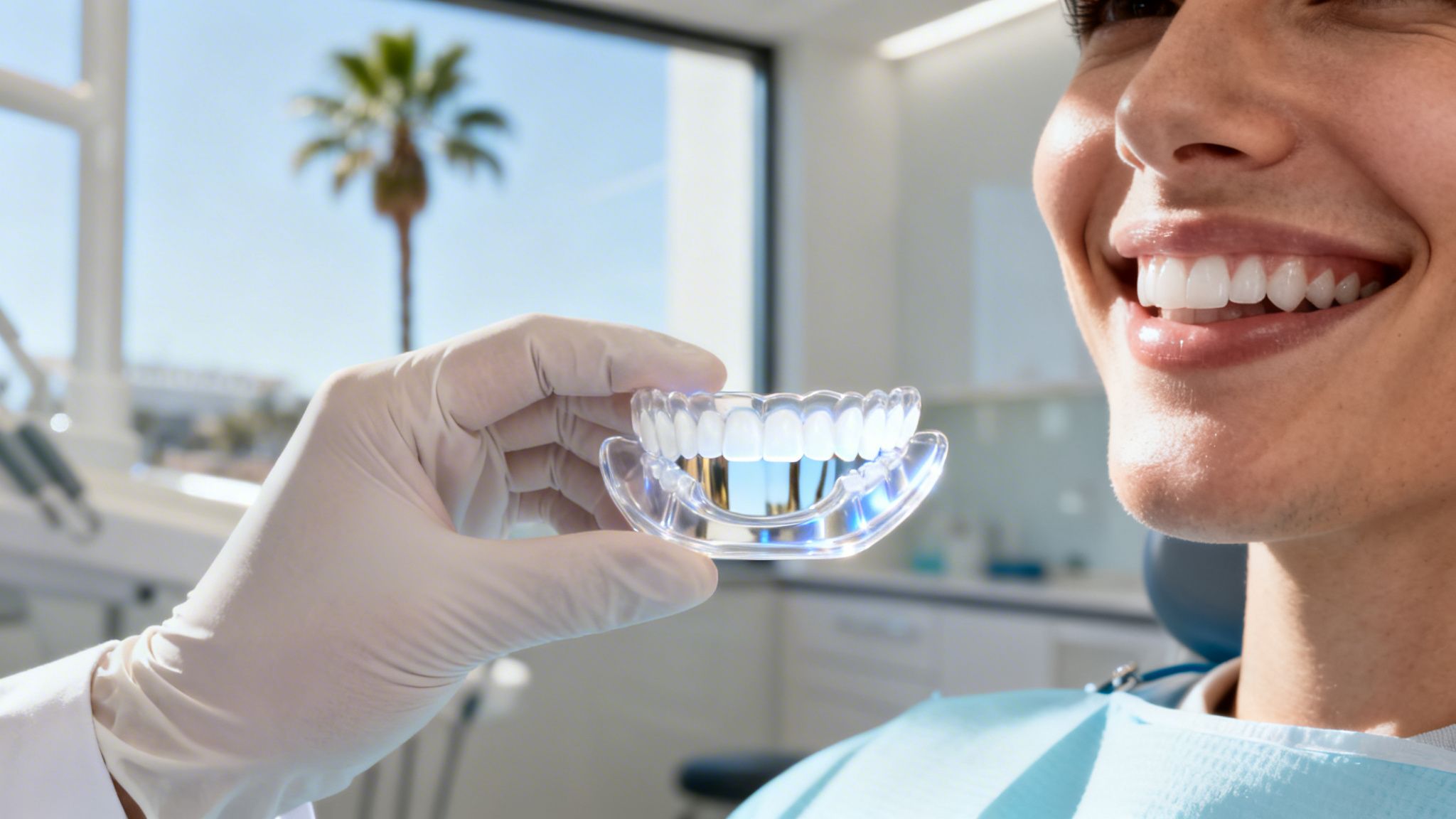
Invisalign Dentist vs Orthodontist: Who Should You Choose?
Invisalign has changed the way millions of people approach teeth straightening. No metal brackets. No tightening appointments. Just a series of clear, custom-fitted aligners that gradually shift your teeth into place. But as the treatment has grown in popularity, so has the number of providers offering it — and that’s where things get a little complicated.
Both general dentists and orthodontists can offer Invisalign. So when you’re ready to start treatment, who do you go to? The answer isn’t always straightforward, and making the wrong choice can mean longer treatment times, less predictable results, or a plan that doesn’t fully address your needs.
This guide breaks down the key differences between seeing a dentist vs. an orthodontist for Invisalign — from training and technology to cost and convenience — so you can make a confident, informed decision about your smile.
What Does Each Provider Actually Do?
Before comparing the two, it helps to understand what each professional is trained to do.
A general dentist completes a dental degree and is qualified to provide a broad range of services: fillings, crowns, cleanings, gum care, and yes, Invisalign. Many general dentists pursue additional Invisalign certification through Align Technology (the company behind Invisalign), which qualifies them to offer the treatment in their practice.
An orthodontist, on the other hand, completes the same dental degree — then spends an additional two to three years in an accredited orthodontic residency program. This postgraduate training is focused almost exclusively on diagnosing and correcting misaligned teeth and jaws. Orthodontics is their specialty, not one of many services they offer.
The distinction matters more than it might seem, especially when treatment gets complex.
Invisalign Dentist vs Orthodontist
Why Orthodontic Specialization Matters
Orthodontists spend years studying tooth movement, jaw development, and bite mechanics. They’re trained to identify issues that aren’t always visible on the surface — things like skeletal discrepancies, bite problems, or the long-term impact of tooth movement on jaw joints.
For straightforward cases (minor crowding, small gaps, mild alignment issues), this depth of training may not make a significant difference. But for moderate-to-complex cases, an orthodontist’s expertise can be the difference between a treatment that addresses the root cause and one that only improves aesthetics.
Invisalign is a powerful tool, but it still requires skilled interpretation and customization. The aligner trays don’t make clinical decisions — the provider does. An experienced orthodontist knows how to use attachments, refinements, and interproximal reduction strategically to achieve results that align trays alone might not accomplish. They also know when Invisalign isn’t the right fit, and what alternative or complementary options exist.
For patients with significant bite issues, jaw misalignment, or a history of complex dental work, an orthodontist’s background provides a more comprehensive safety net.
The Case for Seeing Your General Dentist
There’s a genuine appeal to receiving Invisalign from your family dentist, and it goes beyond just convenience.
Your general dentist already has a complete picture of your oral health. They know your history, your X-rays, your gum condition, and any restorative work you’ve had done. This continuity of care can be genuinely valuable, particularly for patients whose alignment concerns are closely tied to overall dental health.
Many general dentists also invest heavily in Invisalign training and technology. Align Technology’s tiered provider program recognizes dentists at different levels — from Preferred to Diamond — based on their case volume and outcomes. A high-volume general dentist with years of Invisalign experience may, in some cases, be equally capable of handling mild-to-moderate cases as an orthodontist.
The convenience factor is also real. If you’re already seeing your dentist regularly, adding Invisalign to the same practice means fewer new appointments, a familiar environment, and often a smoother administrative experience with your insurance.
Treatment Planning and Technology: A Closer Look
Regardless of which type of provider you choose, the quality of your Invisalign treatment depends heavily on how well your case is planned from the start.
Both dentists and orthodontists use Align Technology’s ClinCheck software to map out the full sequence of tooth movements before treatment begins. This digital treatment plan shows you a projected end result — but building that plan accurately requires clinical knowledge, not just software skills.
Key elements of a strong treatment plan include:
-
Accurate initial records — including 3D scans, photos, and bite analysis
-
Strategic attachment placement — small tooth-colored bumps that help aligners grip and move teeth more precisely
-
Realistic staging — determining how many trays are needed and how quickly teeth should move
-
Anticipating refinements — most Invisalign cases require at least one set of refinement trays to fine-tune results
Providers who regularly treat complex cases — orthodontists in particular — often develop strong instincts for where treatment plans need adjustment before problems arise. That clinical foresight is harder to teach in a short certification course.
When evaluating a provider, ask how many Invisalign cases they complete each year. A higher case volume typically means more hands-on experience with a wider variety of situations.

Invisalign Dental Implant
Cost and Insurance: What to Expect
Invisalign treatment costs vary depending on the complexity of your case, your location, and who provides the treatment. Generally speaking, you can expect to pay anywhere from $3,000 to $8,000 for a full Invisalign course — though this range can shift based on several factors.
Orthodontists sometimes charge more than general dentists for the same treatment tier, reflecting their additional training and specialization. However, this isn’t a universal rule. Some orthodontic practices offer competitive pricing, particularly for straightforward cases.
Insurance coverage is the more important variable for most patients. Orthodontic benefits — when they exist in a plan — typically cover a portion of Invisalign costs, often up to a lifetime maximum of $1,000 to $2,000. Whether you’re treated by a dentist or orthodontist may affect how your insurance classifies the treatment and what percentage they’ll cover.
A few things worth checking before committing:
-
Does your dental plan include orthodontic benefits?
-
Does your provider accept your insurance, and are they in-network?
-
Does the quoted price include refinements, retainers, and follow-up visits?
Both dentists and orthodontists can provide detailed cost breakdowns and help you understand your coverage. Don’t hesitate to request itemized quotes from both before making a decision.
Pegah Salami: A Specialist Approach to Smile Transformations
When it comes to finding the right Invisalign service provider, credentials and case experience are only part of the equation. The best Invisalign outcomes happen when clinical expertise meets a genuine commitment to personalized care.
Pegah Salami exemplifies this approach. With a focus on dental transformations that prioritize both function and aesthetics, Pegah Salami brings a meticulous, patient-centered perspective to every case. From the initial consultation through to the final result, the emphasis is on understanding each patient’s unique smile goals — not just moving teeth, but creating outcomes that feel natural, confident, and lasting.
For patients navigating the dentist vs. orthodontist question, working with a provider like Pegah Salami — who combines specialized knowledge with a thorough treatment philosophy — offers exactly the kind of expertise that complex or cosmetically sensitive cases demand.
How to Choose the Right Provider for Your Smile
So, which route should you take? Here’s a practical framework to help guide your decision.
Consider an orthodontist if:
Your case involves moderate-to-complex crowding, spacing, or bite issues
You have a history of jaw pain or TMJ concerns
You’ve had previous orthodontic treatment that needs correction
You want a provider whose core focus is tooth alignment
Consider your general dentist if:
Your alignment concerns are mild and primarily cosmetic
You have a long-term relationship with a dentist who has significant Invisalign experience
Convenience and continuity of care are high priorities
Your overall dental health requires close monitoring alongside orthodontic work
In both cases, the most important step is a thorough consultation. A good provider — regardless of their title — will take full diagnostic records, walk you through a clear treatment plan, and be transparent about what Invisalign can and cannot achieve in your specific situation. If a consultation feels rushed or your questions go unanswered, trust that instinct.
It’s also worth seeking a second opinion if your case feels complex or the proposed plan doesn’t fully make sense to you. Invisalign is a significant investment of time and money, and you deserve complete confidence in whoever is guiding your treatment.

Invisalign Implant
Take the Next Step Toward Your Best Smile
The dentist vs. orthodontist debate doesn’t have a universal answer. What matters most is finding a provider with the right experience for your case, the technology to plan it well, and the clinical judgment to see it through.
If you’re ready to explore Invisalign and want guidance from someone who takes smile transformations seriously, book a consultation with Pegah Salami today. A personalized assessment is the best way to understand what’s possible for your smile — and who’s best placed to help you get there.





