
A lot of people start searching for the cost of abutment for dental implant at the same moment they start picturing life after a missing tooth is replaced. It might happen over dinner out in San Diego, when you notice you're chewing on one side. It might happen while smiling for photos with family and feeling more aware of the gap than anyone else is. Or it might happen after a tooth extraction, when you realize implant treatment has several parts and the pricing isn’t always explained clearly.
That confusion is common. Patients looking for dental implants near me, a dentist in San Diego, CA, or the best dentist in Rancho Bernardo, CA often hear about the implant itself and the crown on top. The abutment gets mentioned quickly, if at all. Yet it plays a central role in how the final tooth feels, looks, and holds up over time.
If you've been comparing options in Rancho Bernardo, Poway, Rancho Peñasquitos, or nearby San Diego communities, this is usually where the questions begin. Why does the abutment cost vary so much? Why would one office recommend a stock part and another a custom one? And is this one of those “hidden” costs patients only learn about later?
The short answer is that the abutment isn't a small extra. It's the connector that joins the part in the bone to the visible tooth above the gums. That means its shape, material, and fit affect both restorative dentistry and cosmetic dentistry results.
Your Confident Smile is Worth the Investment in San Diego
In San Diego, daily life is social. You meet friends for lunch, head to a family gathering, or stop for a photo near the coast, and a missing tooth can suddenly feel much bigger than it looks on paper. Many people who search for a dentist near me aren’t just asking about treatment. They’re asking if they can get their comfort, confidence, and routine back.

One of the hardest parts of implant planning is that the language sounds unfamiliar. Patients hear words like post, healing abutment, custom abutment, zirconia, torque, crown, and CBCT. By the time cost comes up, it can feel like you're trying to make a major decision in a foreign language.
That’s why clear education matters. When patients understand what each part does, the fee stops feeling random. It starts to make sense as a treatment decision tied to function, appearance, and long term comfort.
Why the abutment causes so much confusion
It's easy to picture the implant screw in the jaw and the tooth-looking crown on top. The abutment sits between them, so it’s less visible and easier to overlook. But that middle piece often explains why one implant quote differs from another.
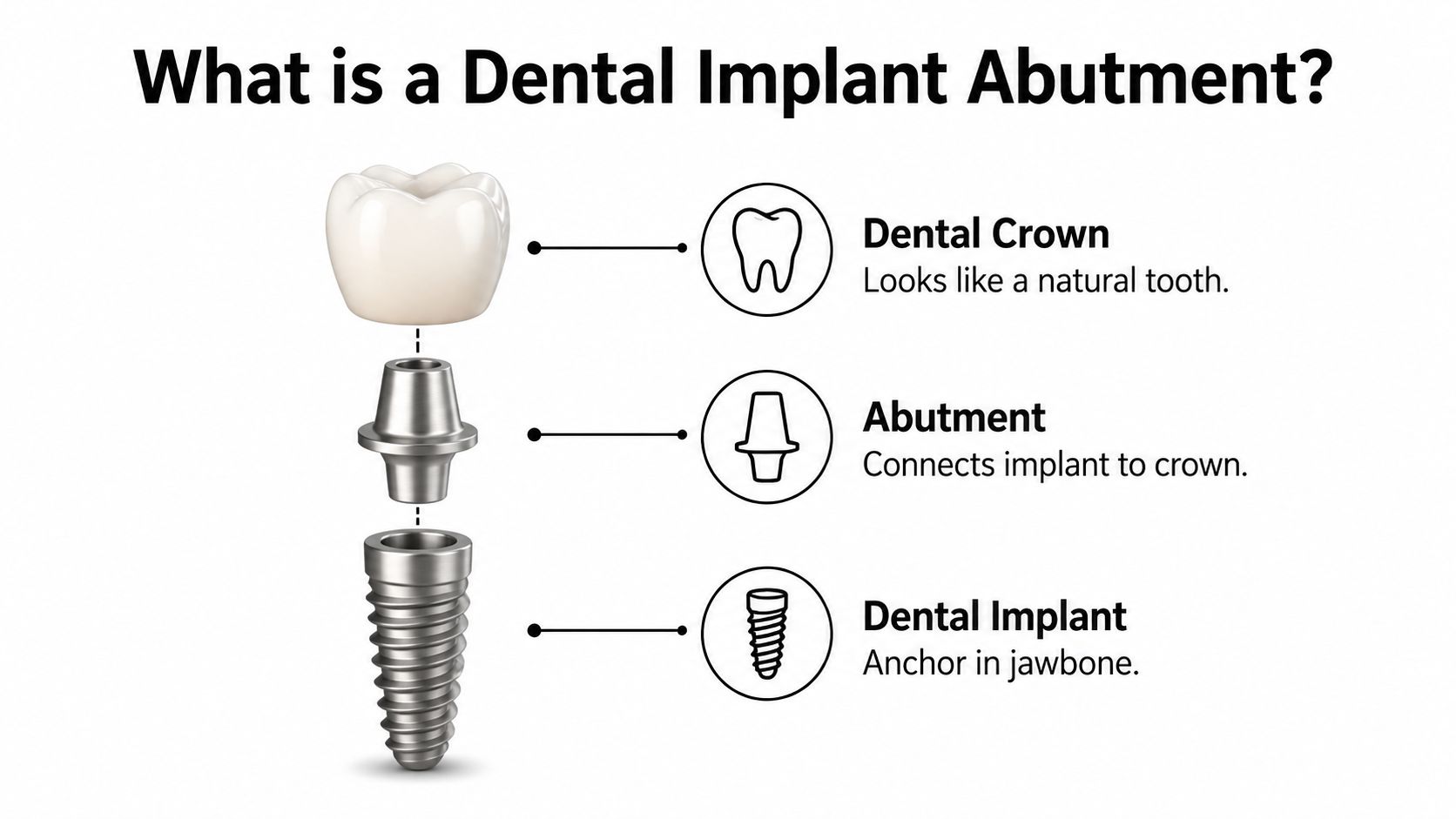
Here’s the simplest way to think about it:
- Implant post: The anchor in the bone.
- Abutment: The connector that rises through the gums.
- Crown: The part that looks like a tooth.
A lower price can sound appealing until you realize you were only comparing one part of a three-part restoration.
Why local patients ask about this first
In Rancho Bernardo and greater San Diego, patients often want both durability and a natural look. That’s especially true when the missing tooth is easy to see when talking or smiling. In those cases, the abutment decision becomes part of the aesthetic plan, not just the mechanical one.
That’s also why the cost of abutment for dental implant deserves its own conversation. It affects how the crown emerges from the gumline, how easy the area is to keep clean, and how stable the final restoration feels when you bite.
What is a Dental Implant Abutment and Why is It Important
A dental implant has three main parts. The easiest way to understand them is to compare the system to a lamp.
The implant post is like the fixed base hidden inside the structure. The crown is the visible top that people notice. The abutment is the connector in between that allows the visible part to attach securely and sit in the right position.
If that middle connector is poorly chosen, the whole setup can look or function off. The crown may not emerge naturally from the gums. Cleaning around it may become harder. The final tooth may even take more force in the wrong direction.
The abutment is the bridge between strength and appearance
Patients sometimes assume the abutment is just a small metal piece, so it shouldn’t matter much. In reality, it does several jobs at once.
- It connects the implant to the crown. Without it, the visible tooth has nothing secure to attach to.
- It helps shape the gumline. The contour of the abutment influences how the gum tissue sits around the new tooth.
- It affects the angle of the final crown. That matters for chewing, speech, and appearance.
- It supports long term maintenance. A better fit often means easier hygiene and fewer trouble spots around the implant.
Why patients notice the result even if they never see the part
You probably won’t ever look at your abutment and admire it. But you will notice what it helps create. You’ll notice whether the implant crown feels stable. You’ll notice whether food traps around it. You’ll notice whether the tooth blends in or stands out.
That’s why the abutment matters in both restorative dentistry and cosmetic dentistry. In back teeth, it helps support function. In front teeth, it often becomes part of the smile design itself.
Practical rule: If a part controls fit, gum shape, and crown position, it isn’t a minor add-on. It’s part of the foundation.
Two common types patients hear about
Most abutments fall into one of two broad categories:
| Type | What it means for patients |
|---|---|
| Stock abutment | Pre-made in standard shapes and sizes |
| Custom abutment | Designed for your specific implant position, gum contour, and final crown plan |
A stock option can work well in the right case. A custom option is often chosen when precision and appearance matter more, especially in the smile zone. That difference is a major reason pricing varies.
For someone searching dental implants near me in San Diego, understanding this one distinction can make a treatment estimate much easier to read. You’re not just paying for a connector. You’re paying for how accurately that connector supports the tooth you’ll use every day.
Key Factors That Determine Your Dental Abutment Cost
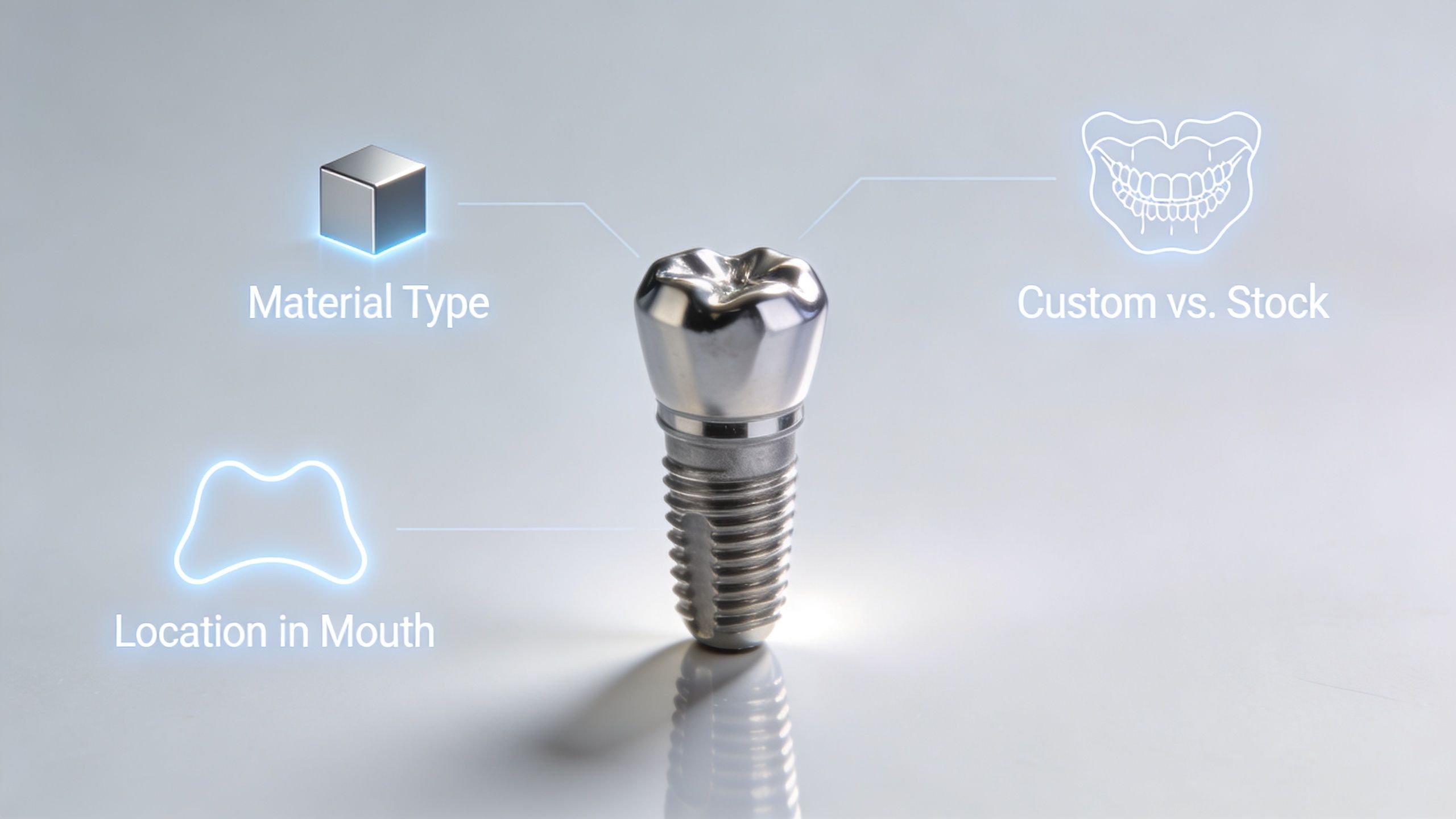
The biggest reason abutment fees vary is simple. Not every implant site needs the same kind of connector. Some cases are straightforward. Others need a part that’s shaped, angled, or milled with much more precision.
If you’ve been comparing treatment plans from a dentist in San Diego, CA or looking for the best dentist in Rancho Bernardo, CA, the distinctions typically become apparent. One office may be planning a basic connector. Another may be planning a custom part designed around your bite, gum tissue, and smile line.
Material changes the fee because it changes the job the abutment can do
Titanium is often chosen for strength and durability. Zirconia is often chosen when appearance matters more, especially if the implant sits near the front of the mouth and the restoration needs to blend naturally with nearby teeth. Hybrid designs can also be used when the plan calls for a balance of strength and esthetics.
Material affects cost because each option has different benefits and fabrication demands. In plain terms, some abutments are selected mainly to hold up under force. Others are selected to do that while also supporting a more natural looking result through the gumline.
Patients who want to learn more about how material choices affect implant restorations can review this page on materials for dental implants.
Stock and custom abutments are priced differently for a reason
This is one of the clearest cost drivers. According to Next Dental Lab’s custom abutment cost breakdown, stock abutments average $50 to $175, while custom abutments average $325 and can range from $200 to $800+. The same source notes that custom designs are important to the 95%+ success rates of implants over 10 to 15 years.
A stock abutment is pre-made. It comes in standard forms and may fit well enough in a routine case. A custom abutment is made for the exact position of your implant and the shape of your gum tissue.
That difference matters in several real-world situations:
- Front tooth replacement: A custom design can help the crown emerge more naturally from the gums.
- Angled implant position: A custom piece can correct or accommodate the path of the crown.
- Tight spacing: Precision may help avoid awkward contours that trap food or complicate flossing.
- Smile aesthetics: A generic shape may work functionally but still fall short cosmetically.
Here’s the practical takeaway. A custom abutment often costs more upfront because someone has to design it, mill it, and tailor it to the restoration. But that added planning can support a cleaner fit and a more lifelike result.
To see a visual explanation of the parts and planning involved, this short video is helpful.
Implant position and anatomy can make the abutment more complex
Not every implant goes into the jaw at a perfectly simple angle. Bone shape, space between teeth, and the location of the missing tooth all influence the design. If the implant must support a crown in a way that redirects force or improves the visible contour, the abutment may need to be more advanced.
That’s one reason the fee isn’t only about the part sitting in a tray. It’s also about planning time, design choices, and how carefully the final crown will meet the gums and opposing teeth.
The more the abutment has to compensate for real anatomy, the more it becomes a precision component instead of a standard part.
Technology and workflow also affect value
When digital planning tools are used, the team can often design the abutment with more control. That matters for fit and crown support. In a high quality implant workflow, the restoration is planned as a full system rather than as separate disconnected steps.
For patients comparing cosmetic dentist near me results with more basic implant offers, this is often the hidden difference. The estimate isn’t just paying for metal or ceramic. It’s paying for the engineering behind how that tooth will sit, function, and blend in for years to come.
Understanding the Price Range for Dental Implant Abutments
When patients ask about the cost of abutment for dental implant, they usually want one clear number. In real life, the honest answer is a range. The fee depends on whether the abutment is standard or custom, what material is used, and how complex the case is.
A good starting point is the national range. According to this U.S. dental implant cost overview, the standalone cost of a dental implant abutment typically ranges from $300 to $1,500. The same source states that the abutment generally represents 10% to 25% of the total single-tooth implant procedure cost.
How the abutment fits into the bigger implant investment
That same source reports that a full single-tooth implant procedure in the United States averages $3,000 to $6,000, including the implant post, abutment, and crown. It also notes that the implant post typically ranges from $1,000 to $3,000 and the final crown from $800 to $3,000.
That breakdown helps answer a common question. Patients sometimes worry that a separate abutment fee means they’re being charged for an unnecessary extra. In most cases, it means the office is being transparent about the individual parts of the restoration.
Here’s a simple way to read an estimate:
| Component | Reported U.S. range |
|---|---|
| Implant post | $1,000 to $3,000 |
| Abutment | $300 to $1,500 |
| Crown | $800 to $3,000 |
| Full single-tooth implant | $3,000 to $6,000 |
Why San Diego patients may see higher quotes
Regional pricing matters. The same source explains that California costs can run higher than in lower-overhead markets. In practice, that often reflects local operating costs, advanced diagnostics, lab coordination, and specialist-level planning that are common in major metro areas.
For patients in San Diego, that means a quote may not match what you see from offices in very different parts of the country. The difference doesn’t automatically mean one office is overpriced. It may reflect a different level of planning, a different restoration approach, or a local cost structure tied to Southern California care.
Price matters, but fit matters more
The important question isn’t only “What does the abutment cost?” It’s “What kind of result is that abutment supporting?” A lower-fee option may be appropriate in some cases. In others, the better long term choice is the one that gives the crown proper support, cleaner contours, and a more natural gumline.
If you’re comparing implant estimates from a dentist near me search, ask for an itemized treatment plan and ask what type of abutment is included. That single question often reveals why prices differ.
A transparent estimate should show you whether the office is planning a basic connector or a restoration designed around your actual anatomy.
Insurance Coverage Financing and Managing Implant Costs
Even when patients understand why the abutment matters, they still need a workable plan to pay for treatment. That’s where many people pause. They may be ready for implant care, but unsure how much insurance helps, whether monthly financing is available, or how to budget the treatment without surprises.
The first thing to know is that coverage varies widely. Some dental plans contribute to parts of implant treatment, while others place strict limits on major restorative services. Some plans may help with diagnostics or the crown portion but not every part of the implant system.
What to ask your insurance provider
A short phone call or benefits review can save a lot of confusion. When you speak with your insurer, ask questions in plain language:
- Implant benefits: Does the plan cover the implant, the abutment, the crown, or only certain portions?
- Annual maximums: Is there a yearly cap that affects how much can be applied?
- Waiting periods: Do you have to be enrolled for a period of time before major treatment is covered?
- Missing tooth clauses: Are there rules that limit coverage if the tooth was lost before the policy began?
Patients often assume “implant coverage” means every part is included. It often doesn’t. That’s why a written estimate matters so much.
Ways patients make treatment more manageable
Many offices offer staged treatment plans or outside financing so the full fee doesn’t have to be paid all at once. This can be especially helpful for patients who are replacing a visible tooth, planning after a tooth extraction, or balancing implant treatment with other care like cleaning and exams, dental x-rays, or a new patient exam.
Common budgeting tools may include:
- Monthly financing plans: Third-party healthcare financing can spread payments over time.
- Health savings funds: If you use pre-tax healthcare dollars, it helps to start with understanding health savings accounts so you know how these accounts may fit into dental planning.
- Phased care: In some cases, treatment can be scheduled in stages so costs are timed more comfortably.
- Written payment discussions: A clear estimate helps you compare immediate needs with elective timing.
For a patient-friendly overview of planning options, this guide on budgeting for dental implants and payment options that make it easier is a useful resource.
Money questions are healthcare questions. You shouldn't have to guess what’s covered, what’s optional, or when charges will happen.
A practical way to approach the decision
If you feel stuck, don’t try to solve the whole case in your head. Start with the first step. Get an exam, imaging if needed, and an itemized treatment plan. Once you know whether your case calls for a stock or custom abutment and what else is involved, the financial picture usually becomes much easier to understand.
That kind of clarity helps patients make steady decisions instead of reacting to a big total without context. It also helps separate true need from assumptions, which is especially valuable if you're searching for an emergency dentist after a broken tooth or planning a long term restorative solution.
Your Dental Implant Journey with Dr Salami in Rancho Bernardo
Choosing implant treatment is about more than replacing one tooth. You’re choosing how carefully the entire restoration will be planned. In Rancho Bernardo, patients often want care that feels personal, organized, and calm, especially if they’ve had rushed dental experiences elsewhere.
That experience usually starts with listening. Before anyone talks about the final crown, the conversation should focus on your goals, your comfort level, the location of the missing tooth, and what matters most to you. For some patients, that’s appearance. For others, it’s chewing comfortably again. Often, it’s both.
Planning first creates a better result later
Implant success depends on precision. According to this implant and crown breakdown, suboptimal angulation can lead to complications, while custom designs, often planned with CBCT scans, reduce failure rates to less than 1%. The same source states that this level of precision contributes to 97% 10-year crown retention rates.
That matters because the abutment isn’t selected in isolation. Its design depends on where the implant is placed and how the final crown needs to sit. A small difference in angle can change how force travels through the restoration and how natural the tooth looks at the gumline.
What patients can expect during the process
Every case is different, but a high-quality implant process often includes these stages:
Consultation and exam
The team reviews your oral health, your bite, your concerns, and whether implant treatment is the right fit.Digital imaging and planning
Advanced tools such as CBCT help map bone structure and guide more precise planning.Implant placement and healing
The implant integrates with the jaw before the final restoration is attached.Abutment and crown phase
This is where fit, tissue support, and aesthetics come together.Follow-up and maintenance
Long term health depends on cleanability, regular checkups, and monitoring the restoration over time.
Why technology changes the patient experience
For patients with dental anxiety, better planning often means a calmer experience. Digital imaging can reduce guesswork. Same-day CAD/CAM systems such as CEREC can streamline parts of restorative care when appropriate. A thoughtful workflow can also help patients understand what’s happening instead of feeling rushed from one appointment to the next.
That’s especially important for families in Rancho Bernardo, Poway, and Escondido who are already juggling work, school, and daily life. They want dentistry that is organized, clear, and respectful of their time.
Precision isn't just about equipment. It's about using the right tools so the restoration fits your mouth instead of asking your mouth to adapt to a generic plan.
For patients looking for a dentist near me who offers both family care and advanced restorative dentistry, that blend of education, comfort, and technology often makes the biggest difference.
Frequently Asked Questions About Implant Abutment Costs
Does every dental implant need an abutment
Yes. If you’re replacing a tooth with a traditional implant restoration, the implant post and the crown need a connecting component. That connector is the abutment.
Is a custom abutment always better
Not always. A stock abutment can work well in the right case. A custom one is often preferred when the tooth is in the smile zone, when the implant angle is more challenging, or when the gum contour needs a more precise result.
Can an abutment be replaced if it’s damaged
In many cases, yes. Whether replacement is simple depends on the implant system, how the crown was made, and what caused the damage. That’s one reason precise planning and quality components matter from the start.
Why isn’t the abutment always included in an advertised implant price
Some offices advertise only one part of the procedure. The full restoration usually includes the implant post, the abutment, and the crown. Asking for an itemized estimate is the best way to avoid confusion.
Will insurance pay for the abutment
Sometimes, but it depends on the plan. Some policies cover portions of implant care, while others limit or exclude parts of the treatment. It’s best to verify benefits before treatment starts.
How do I get a personalized estimate
Start with an exam and a treatment consultation. The exact fee depends on your implant location, the type of abutment needed, and the overall restorative plan. A personalized evaluation gives you the most accurate answer.
If you're ready to get clear answers about the cost of abutment for dental implant, schedule a consultation with Pegah S. Salami, DMD, FAGD. You’ll get a personalized evaluation, a transparent treatment discussion, and a practical plan for restoring your smile with confidence in Rancho Bernardo and greater San Diego.





